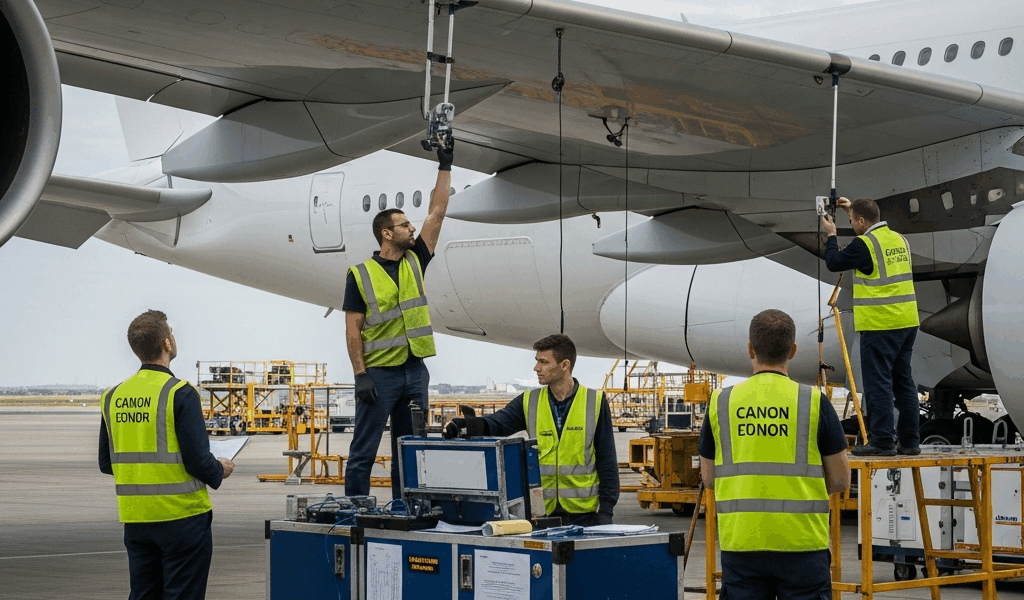
European regulators have ordered urgent inspections of 16 Airbus A380 aircraft after maintenance workers discovered wing mid-spar cracks. The European Union Aviation Safety Agency (EASA) issued the emergency directive on June 22, 2026, effective June 24, 2026. Five Emirates planes must be inspected immediately, while the remaining 11 aircraft have 25 flight cycles to complete their checks.
The emergency directive (EAD 2026-0119-E) covers A380-841, A380-842, and A380-861 variants operated by Emirates and Qantas. Fifteen of the 16 affected aircraft belong to Emirates; one belongs to Qantas. Emirates’ Group 1 aircraft—those requiring immediate inspection—carry MSNs 190, 202, 203, 209, and 228. Group 2 aircraft carry MSNs 30, 42, 55, 56, 105, 142, 184, 187, 208, 227, and 234 and must be inspected within 25 flight cycles. The Qantas aircraft, registered VH-OQI, has been parked in Dresden, Germany since March 8 for scheduled maintenance.
EASA stated that “cracks found on certain aeroplanes could reduce the structural integrity of the wing.” The cracks affect the wing mid-spar structure—a critical load-bearing element that distributes aerodynamic forces during flight. Technicians will use non-destructive testing methods, including ultrasonic scanning and eddy-current inspection, to find cracks that aren’t visible to the naked eye without taking apart major structural components.
Inspection Timeline and Grounding Provisions
Group 1 aircraft cannot carry passengers until inspections and any necessary repairs are finished. EASA allows ferry flights to transport the five affected jets to maintenance facilities. Group 2 aircraft must complete inspections within 25 flight cycles of June 22, 2026. Operators have seven days to report their results to Airbus and EASA—whether or not they find cracks.
This directive follows an earlier EASA order from December 2025 (AD 2025-0280) that required mid-spar inspections on A380s returning to service after storage. That order addressed hydrogen embrittlement risk—a condition from prolonged storage, especially common during COVID-19 fleet reductions—that can cause cracking in certain alloys.
Operator Response and Operational Impact
Emirates will comply and carry out the inspections required in accordance with the airworthiness directive. We remain in close contact with Airbus and the relevant authorities to minimise any disruption to the operating schedule.
Emirates said inspections would begin within 48 hours of the directive taking effect. The Dubai-based carrier operates more than 100 A380s—nearly half of the 251 aircraft delivered globally before Airbus stopped production in 2021. The airline has committed to flying the A380 until 2041 and plans to expand its active fleet to 110 aircraft through a multi-year cabin retrofit programme.
A Qantas spokesperson said: “We have one A380, which requires additional inspections. The aircraft was already in scheduled maintenance, and we will comply with any additional requirements as a result of this airworthiness directive.”
Airbus said it is “supporting the inspection of these five aircraft” and will “assess with EASA whether repairs are necessary or if the aircraft can return to commercial service” based on what inspectors find.
Historical Context and Future Outlook
This is the third major A380 wing structural directive in 15 years. In 2012, EASA ordered inspections of all 67 A380s in service at that time for wing cracks caused by manufacturing defects—repairs that cost Airbus €105 million. A 2019 directive addressed outer rear spar (ORS) cracks in 25 aircraft operated by Singapore Airlines, Air France, Lufthansa, and others.
The current directive focuses on mid-spars—interior wing box beams—marking a new structural concern. EASA has not grounded the entire A380 fleet and indicates no imminent fleet-wide safety risk, but emergency directives are rare and typically used only for issues that could affect airworthiness.
Inspection results could lead to directive expansion or changes. Airbus is also preparing service bulletins that will require repetitive slat inspections during scheduled A and C maintenance checks, part of broader structural monitoring efforts for the aging airframe.
Sources
- aviationnews-online.com
- aviation24.be
- EASA Emergency Airworthiness Directive 2026-0119-E (June 22, 2026)
- FlightAware aircraft tracking data
- Gulf News, June 24, 2026
- AeroXplorer coverage by Stacey Van Der Merwe, June 23, 2026



Stay in the loop
Get the latest aviation news updates delivered to your inbox.