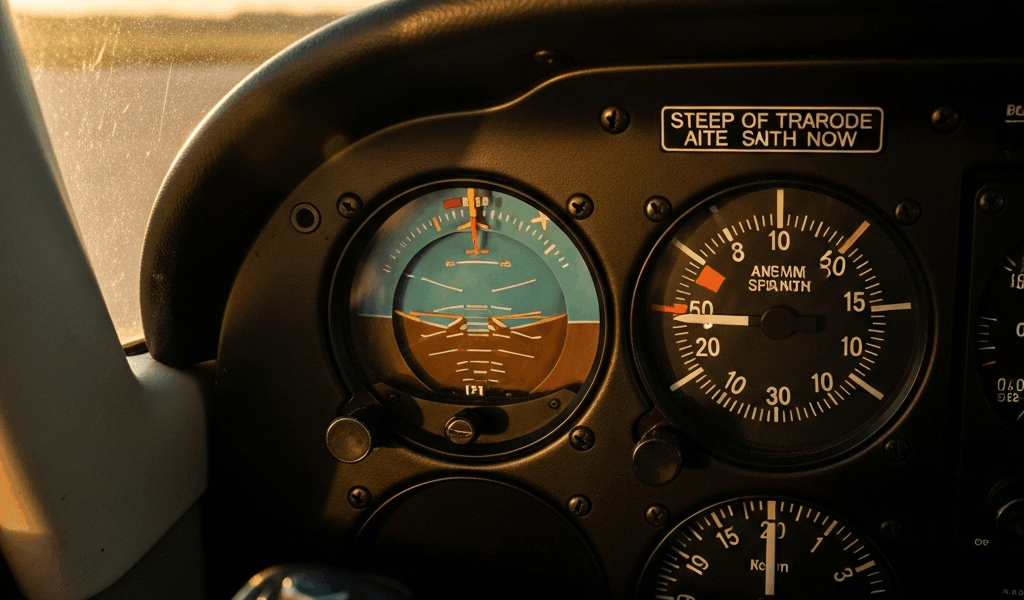
The Most Common Stall Recovery Mistake Pilots Make
Stall recovery techniques pilots practice wrong start with panic — and I’ve watched checkride candidates freeze solid on the controls, then overcorrect with inputs aggressive enough to make everything worse. The single biggest error I see across flight schools isn’t missing knowledge. It’s the psychological response to that stall warning horn combined with a fundamental misunderstanding of what the wing actually needs to recover.
A stall is an angle-of-attack problem, while the airplane’s subsequent motion reflects the net aerodynamic and gravitational forces. This overview of the four forces of flight provides the foundation for understanding why reducing angle of attack restores controlled flight.
When a stall happens, most pilots do one of two things: pull back harder on the yoke (trying to “recover” upward) or slam the nose down with aggression. Both are wrong, honestly. The pulling-back reflex comes from panic — your brain registers “losing altitude, must pull up.” But the nose-down slam? That comes from overcorrection and from instructors teaching “push the nose down hard to unstall the wing.” That phrase alone is dangerous.
Here’s what’s actually happening aerodynamically. Your wing stalls when angle of attack exceeds critical angle. Pulling back increases that angle of attack further — makes it worse. Slamming the nose down aggressively does unstall the wing, yes. But it often does so too violently, trading altitude for airspeed at a ratio that leaves you with nothing to work with. I trained with an instructor who had me practice stalls in a Cessna 172 at 3,000 feet. One recovery, I pushed the nose down like I was diving away from a ground collision. We dropped 800 feet before I had any airspeed back. That was inefficient and dangerous.
The real failure emerges during actual checkrides. Two scenarios I’m aware of: pilots who either froze and kept the nose pitched up (stall deepened), or pushed over so aggressively during a secondary stall scenario that the examiner called the ride. Neither pilot was incompetent — both had practiced stalls. They just practiced the wrong way.
Step 1 — Reduce Angle of Attack, Not Just Push the Nose Over
The distinction here matters more than most instructors will admit.
Reducing angle of attack means you’re moving the elevator control forward smoothly — not jerking it, not panicking — to decrease the wing’s pitch relative to the oncoming air. It’s a measured, coordinated input that lets the wing resume normal airflow without trauma. Your hand moves forward on the yoke maybe two to three inches, and you feel for the control response rather than forcing it. That’s the whole input.
Pushing the nose over is what happens when you’re panicked. You’re trying to make the nose visibly drop — aggressively. The result is too much pitch change too fast. The aircraft dives instead of recovering smoothly. You lose altitude unnecessarily. Sometimes 300 to 500 feet on a stall that should only cost you 50.
The airspeed and altitude recovery trade-off is the real lesson. When you pitch nose-down aggressively, you’re converting altitude into airspeed at maximum rate. That’s sometimes required at 5,000 feet near terrain. But most training stalls happen at altitude where a shallow pitch change works perfectly fine. You reduce angle of attack, airspeed builds gradually, and by the time you have flying speed again, you’ve only lost what you actually needed to lose.
Probably should have opened with this section, honestly. Most students don’t understand why the input feels so small. They’re waiting for something dramatic to happen. Instead, the stall just breaks, the stick shaker stops, and you’re flying again. That’s correct. The drama is the failure mode.
Step 2 — Apply Full Power and Level the Wings
This is where instructors diverge, and where the confusion actually starts.
Standard procedure — what most FAA examiners expect — is to reduce angle of attack first, then apply power. Some instructors teach power-first though. The reasoning: applying power while the wing is still stalled can cause an accelerated stall or a secondary stall if you’re not smooth. Valid concern. Other instructors argue power should go in immediately because you need energy back to the aircraft right away.
Here’s the middle ground that actually works: reduce angle of attack and add power almost simultaneously. Not power first, not pitch first — both at the same time with smooth, coordinated motion. Your left hand reduces pitch. Your right hand advances the throttle. They happen within a one-second window. The wing unstalls while the engine is building energy back.
Leveling the wings happens next, and this is where pilots often make a second mistake — and a costly one. You’re pitched down, nose is coming up, and the airplane rolls to one side. Pilots get tunnel vision on pitch recovery and forget to correct roll. You end up in a spiral instead of a level recovery. The correct sequence: reduce angle of attack, add power, step on the ball to correct yaw, use ailerons to level wings. All of this happens in maybe three to five seconds on a standard stall recovery.
The common error of forgetting to level wings while pitching down costs altitude. A lot of it. I’ve seen pilots recover the stall — airspeed comes back, pitch looks reasonable — but the airplane is still banked 20 degrees. They’re actually in a descending turn, still losing altitude, and they don’t realize it until the examiner points it out. By then, the ride is usually over.
Step 3 — Recover to Level Flight, Avoid Overstress
Smooth recovery beats aggressive recovery. Every time.
Once the wing is flying again, the pullout from the descent is where most pilots make their final error. They’re coming out of the dive with airspeed building, and they pull hard to get back to level flight quickly. That creates excessive G-loading. Aircraft have structural limits — a Cessna 172 is limited to 3.8 Gs positive. A Beechcraft Bonanza is 3.8 Gs as well. Aerobatic aircraft go to 6 Gs or more. Your job during recovery is to level off gradually, keeping G-loading between 1.5 and 2.5 Gs, and absolutely never exceeding the aircraft’s limit.
The reason instructors sometimes fail to emphasize this: they’re focused on the stall recovery itself, not on what comes after. The stall is broken. Airspeed is coming back. Students think they can now fly aggressively. That’s wrong. You’re still in recovery. You’re still vulnerable to structural damage if you yank the yoke back.
How do you judge recovery aggressiveness by altitude? Simple math. Stall at 5,000 feet, lose 500 feet recovering, you land at 4,500 feet. Safe. Stall at 2,000 feet, lose 500 feet, you land at 1,500 feet. Still probably safe depending on terrain, but close. Stall at 1,200 feet in a commercial operation, a 500-foot loss might be unacceptable. That’s why recovery technique changes with altitude. Lower altitude demands smoother, more efficient recovery. Higher altitude gives you room to recover with more normal aggressive inputs.
Why Flight Schools Teach Stall Recovery Inconsistently
The FAA and EASA don’t describe stall recovery the same way. FAA guidance emphasizes angle of attack reduction. EASA emphasizes pitch control and wing-leveling in a specific order. Neither is wrong, but they’re different enough that a pilot trained in Europe learning to fly in the US gets confused. Instructors trained 20 years ago use different language than instructors trained today. Older pilots learned “push the nose down.” Newer instructors teach “reduce angle of attack smoothly.”
High-performance aircraft stall differently than trainers. A Cirrus SR22 has electronic stability systems that can actually prevent stalls. A Piper Cub doesn’t. Recovery technique varies slightly by aircraft behavior. Some instructors account for this. Others use the same procedure for every airplane, which works but misses important nuance.
This article exists partly because that gap creates anxiety for checkride candidates. You’ve practiced with Instructor A who emphasizes power-first. Your examiner learned under a different methodology. Suddenly you’re second-guessing yourself during a stall recovery on a checkride. This section is meant to validate that the confusion is real, not imaginary.
Practice Method That Actually Sticks
Use altitude gates. Start stall practice at 3,000 feet minimum above ground level. After the recovery, you should not be below 2,500 feet — that’s your target. Losing 600 feet per recovery means your technique needs work. Losing 200 feet? You’ve got it dialed in.
G-loading ranges: practice with a G-meter if your flight school has one. You should see 1.2 to 2.0 Gs during recovery. Anything above 2.5 means you’re being too aggressive on pullout. Anything below 1.2 might indicate you’re being too gentle and recovering too slowly — which costs altitude.
Different aircraft require small adjustments. Practice stalls in whatever aircraft you’ll be flying. A high-wing Cessna handles differently than a low-wing Piper. Taildraggers are completely different. Don’t assume one procedure fits all.
Final critical point: distinguish inadvertent stalls from full stalls. An inadvertent stall is a surprise — you’re not expecting it, it happens fast, recovery is instinctive. A full stall is where you hold it stalled intentionally. Recovery procedures differ slightly because your starting conditions are different. Know both.



Stay in the loop
Get the latest aviation news updates delivered to your inbox.