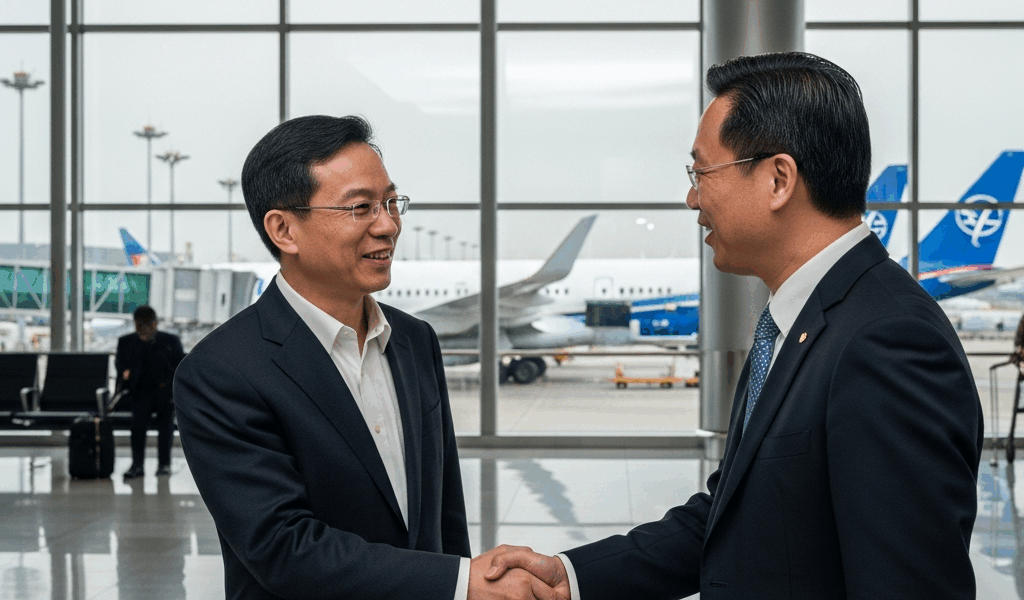
China’s Ministry of Commerce formally confirmed on May 20 that the country will purchase 200 Boeing commercial aircraft. It’s the first major order from Beijing since 2017—and a notable shift after years of trade tensions and safety-driven groundings strained U.S.–China aviation relations.
The announcement came one week after President Donald Trump disclosed the deal during his state visit to Beijing on May 14. As Trump departed China on May 15, he told reporters the order could expand to as many as 750 aircraft if Boeing executes well on the initial 200-unit commitment, though that expansion remains conditional and unconfirmed.
China’s Commerce Ministry grounded the purchase in “commercial principles and its own needs for air transport development,” framing it as part of broader U.S.–China trade normalization. The statement also noted that Boeing will supply aircraft engine parts and components through GE Aerospace—positioning the order as bilateral industrial cooperation.
Order Details Remain Incomplete
Boeing hasn’t issued a formal press release detailing aircraft models, delivery timelines, or dollar value. That’s a conspicuous gap for a transaction of this size. Analysts had speculated the order would include a mix of narrowbody 737 MAX variants and widebody aircraft such as the 787 Dreamliner and 777X, reflecting China’s fleet modernization priorities—but the specific breakdown hasn’t been disclosed.
The 200-unit commitment fell well short of Wall Street expectations. Jefferies and other analysts had forecast orders of around 500 aircraft, particularly given that Boeing CEO Kelly Ortberg traveled with Trump to Beijing and met with Chinese Premier Li Qiang during the summit. Boeing’s stock closed 4.73% lower on Thursday, reflecting investor disappointment over the lower-than-anticipated volume.
Trump offered a telling detail: “Boeing wanted 150, got 200″—suggesting internal Boeing projections had been considerably more modest. During Boeing’s Q1 2026 earnings call last month, Ortberg told investors that securing Chinese orders represented “a meaningful opportunity for us,” though he declined to specify quantities.
Strategic Implications and Competitive Backdrop
The order comes at a pivotal moment. Boeing is still recovering from production bottlenecks, quality control issues, and the 737 MAX crisis. The company maintains a record backlog of $695 billion and delivered 143 aircraft in Q1 2026. Boeing’s CFO stated in April that the company has encountered no material supply chain disruptions or delivery deferrals.
Airbus had captured substantial market share during Boeing’s absence from China. In December 2025, Air China ordered 60 A320neo family aircraft, followed by a 137-aircraft commitment from China Southern and Xiamen Airlines in April 2026. China represents the world’s second-largest aviation market—and Boeing projects Chinese carriers will require nearly 9,000 new aircraft over the next 20 years.
The deal fits within the broader diplomatic framework informally known as the “three Bs”—Chinese purchases of beans, beef, and Boeing aircraft. U.S. Treasury Secretary Scott Bessent had signaled in advance that “large Boeing orders” were expected as part of the summit. He also noted ongoing negotiations for a potential joint U.S.–China board of trade and reciprocal tariff reductions on approximately $30 billion in goods.
What’s Next
Several details remain outstanding: specific aircraft model allocation, individual airline assignees, delivery schedules, and the dollar value. Boeing’s next opportunity to address these specifics will come during its Q2 2026 earnings release, typically scheduled for late July. The potential expansion to 750 aircraft hinges on Boeing’s ability to execute the initial 200-aircraft delivery schedule without delays.
Sources
- CNBC — China Confirms 200 Boeing Aircraft Order
- Boeing Q1 2026 Earnings Call
- China Ministry of Commerce Official Statement, May 20, 2026
- U.S. Treasury Department Press Briefing
- White House Press Pool, Beijing, May 14–15, 2026

Stay in the loop
Get the latest aviation news updates delivered to your inbox.