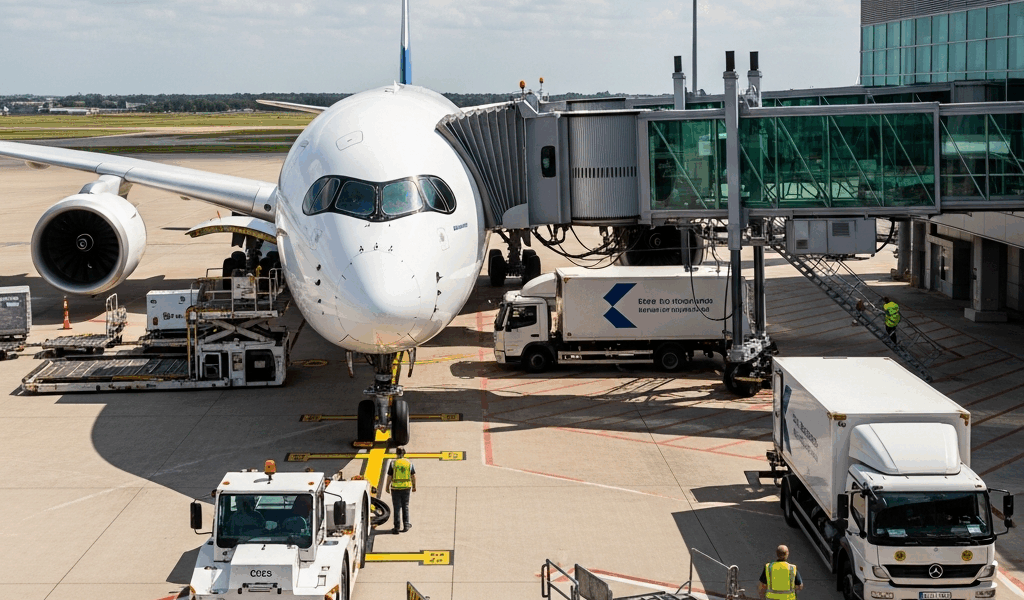
Airbus announced record-breaking financial results for the first half of 2026 on July 29. The European manufacturer reported a commercial aircraft order backlog of 9,222 units—the highest in company history—while delivery volumes jumped 14.7% year-over-year to 351 aircraft.
The company delivered 351 commercial aircraft in H1 2026, compared to 306 in the same period last year. A record 237 deliveries came in the second quarter alone. Gross commercial orders totaled 886 aircraft: 178 A220s, 605 A320-family jets, 37 A330s, and 66 A350s. This robust intake expanded the backlog to an all-time high—representing multi-year guaranteed revenue as global airlines continue expanding capacity and renewing fleets.
Market preference clearly favors larger variants. The A320-family backlog stands at 7,467 aircraft, with approximately 75% being the stretched A321 model. The widebody order book comprises 1,124 A330/A350 aircraft combined.
Financial Performance Accelerates
H1 2026 revenue rose 12% to €33.2 billion. Adjusted EBIT climbed 70% to €2.75 billion, while net income increased 47% to €2.24 billion, yielding earnings per share of €2.84, up from €1.93 a year earlier. The commercial aircraft division drove much of this growth—revenue up 15% to €23.9 billion with adjusted EBIT of €1.99 billion.
Free cash flow before customer financing came in at negative €1.17 billion, an improvement from negative €1.61 billion in H1 2025. Inventory buildup to support production ramp-up moderated cash outflows. Gross cash stood at €23.4 billion at June 30.
CEO Guillaume Faury said: “Our good H1 results mainly reflect the higher level of commercial aircraft deliveries and strong performance in Defence and Space, against the backdrop of a complex and fast-changing environment. We are ramping up across all businesses to meet the growing demand for our civil and military solutions.”
Production Targets and Supply Chain Normalization
Airbus has set aggressive production targets. The company aims for 13 A220s monthly by 2028, 70–75 A320-family aircraft by end-2027 (stabilizing at 75 thereafter), 5 A330s by 2029, and 12 A350s by 2028. Management aspires to exceed 100 aircraft per month across all programs combined—but only if supply chains remain stable.
Engine availability remains the primary bottleneck. Pratt & Whitney GTF supply shortages for A320neo-family aircraft have constrained output, though Faury indicated the situation has normalized: “We have no gliders in the sense of aircraft not being delivered solely because of engines. So we are in a normalized situation.”
Airbus confirmed full-year 2026 guidance of approximately 870 commercial aircraft deliveries, adjusted EBIT around €7.5 billion, and free cash flow before customer financing of approximately €4.5 billion. This assumes no additional disruptions to global trade, air traffic, or supply chains and includes current tariff impacts.
Notable Orders and Market Dynamics
Major orders came through in H1 2026. AirAsia made a firm commitment for 150 A220-300s—the largest single order in the program’s history and making AirAsia a new A220 customer. Scandinavian Airlines ordered 18 A330-900s for long-haul fleet renewal.
This delivery acceleration positions Airbus to regain market-share momentum against Boeing, which has faced production disruptions related to 737 MAX certification and manufacturing quality issues. Airbus entered 2026 with a backlog of 8,754 aircraft, providing visibility into sustained production through the decade.
Airbus will report Q2 2026 detailed financial statements on October 30 and host an investor update at the Farnborough International Airshow, where management is expected to detail production scaling plans and supply chain mitigation strategies.


Stay in the loop
Get the latest aviation news updates delivered to your inbox.