“`html
Why Commercial Checkrides Have Higher Failure Rates Than Private
Commercial pilot checkride failures happen more often than most people realize. The FAA doesn’t publish a single official failure rate, but flight instructors and examiners consistently report that commercial candidates wash out at roughly double the rate of private pilot applicants — and honestly, after three years training commercial-level pilots, I see why immediately. The jump in rigor is relentless.
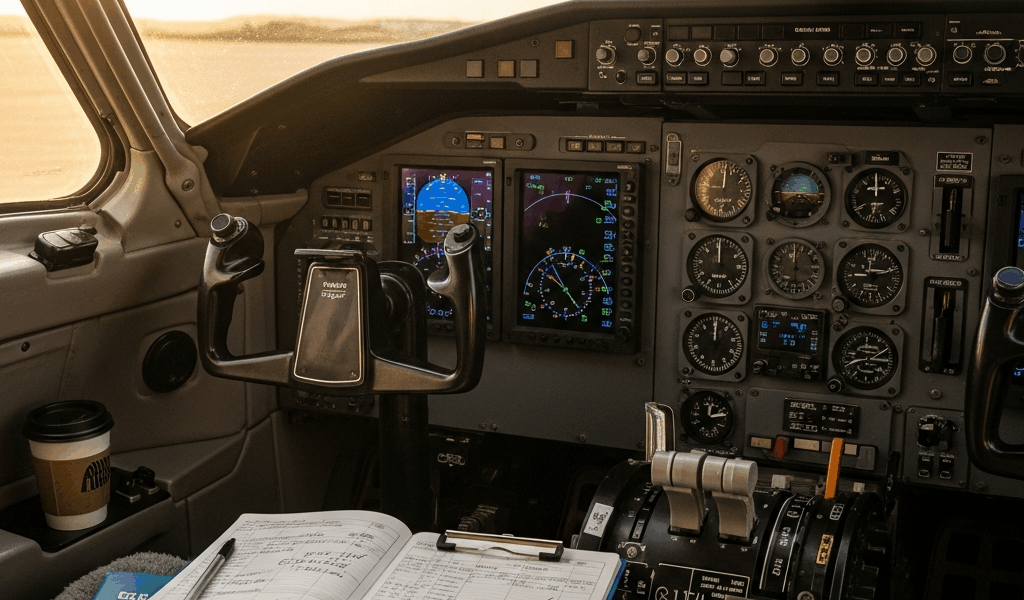
The difference isn’t just about harder maneuvers. Commercial certification demands a fundamentally different operating mindset. Private pilots can be proficient and cautious. Commercial pilots? They’ve got to be proficient, sharp, and decisive under pressure — especially in complex aircraft. You’re flying a Piper Cherokee 6, a Beechcraft Baron, or a Cirrus SR22. Multi-engine considerations. Pressurization systems. Turbocharging. Weight-and-balance calculations that actually matter because you’re carrying cargo or multiple paying passengers.
Examiners care about judgment more than anything else.
A private pilot can refuse a flight because the weather is marginal. A commercial pilot gets asked, “What would you do if a charter company insisted you fly this route in these conditions?” That’s not rhetorical. Examiners test judgment through scenario-based questioning and through how you handle failures during the practical test. Poor decision-making — that’s what kills commercial checkrides faster than technique flaws ever will.
Oral Exam Failures Examiners Report Most
Struggling through the oral is where most commercial candidates lose ground before they even touch the airplane. I’ve watched this pattern repeat enough times to know exactly what examiners are looking for — and what trips people up.
Systems knowledge on the actual test aircraft. Do you know why your airplane stalls at a higher airspeed in a turn than in straight-and-level flight? Can you explain the relationship between density altitude and true airspeed? Can you tell me what a “loaded CG” does to your stall speed, and why that matters for your charter operation?
I watched a candidate fail once because he couldn’t explain why a Piper Seneca — that twin-engine trainer — has counter-rotating propellers. He’d flown the thing, sure, but he didn’t understand why the design existed. The examiner pushed: “What happens if you lose the left engine?” Complete freeze. That’s a systems knowledge failure, full stop.
Weight-and-balance reasoning, not just calculations. You might nail the math on your E6B, but examiners ask follow-up questions that expose surface-level understanding. “You calculated CG at 38.5 inches aft. What does that mean for your pitch control? If you pick up three passengers instead of cargo, how does that change your load factor in a maneuver?” Pilots who memorize numbers without building a mental model of how weight distribution affects flight characteristics — they fail here, consistently.
Crosswind and density-altitude decision-making. Here’s where I see judgment failures most. A candidate knows the airplane’s crosswind limit is 15 knots. The examiner asks: “It’s 2,800 feet elevation, temperature is 35 degrees C, and the wind is gusting to 18 knots, 25 degrees off the runway. Go or no-go?” That’s not about knowing a number. That’s about integrating runway length, aircraft performance charts, and real-world margins — all while your brain is already stressed. Probably should have opened with this section, honestly — it’s where oral failures snowball into test cancellations.
Multi-engine operations (if applicable). VMC is a number. But do you understand why VMC increases with weight? Why it changes with bank angle? Why a crosswind changes your effective VMC? Candidates who memorize “70 knots VMC” instead of understanding the aerodynamics get torn apart when examiners ask what-if scenarios. That’s when you realize you didn’t actually understand it.
Practical Test Maneuver Failures and How to Fix Them
The practical phase is where technique meets precision — and commercial standards are noticeably tighter than private pilot PTS tolerances. We’re talking about a different level of control.
Steep turns. Commercial PTS requires maintaining altitude within 100 feet and roll-out heading within 10 degrees. That’s achievable. But what kills most candidates? The approach to the maneuver. They enter at 1,500 feet per minute descent, correcting constantly, flying sloppy turns throughout. Here’s what actually works: enter the maneuver shallowly, establish stable altitude, then roll to 20 degrees. Make small control inputs. The examiner isn’t testing your raw strength — they’re testing whether you can fly with precision without constantly chasing the airplane.
Recovery failures happen when pilots over-correct. You’re rolling out and you’re 15 degrees high. You pull hard. Now you’re diving. Instead of understanding that a 15-foot altitude excursion during recovery is acceptable — the PTS actually allows it — candidates panic and pull harder. That’s the mistake.
Lazy eights. This maneuver exposes coordination and planning problems immediately. You need consistent altitude gain and loss, smooth roll rates, and heading changes that hit your 10-degree increments. Most failures happen because pilots over-bank early or under-bank, leading to sloppy altitude control and heading misses. Plan your altitude profile before you start. Know that at 45 degrees of bank, you’ll need consistent pitch application to maintain your altitude gain. The airplane’s already telling you what it needs — you just have to listen.
Constant airspeed climbs and descents. Examiners want you holding +/- 10 knots. Simple, right? In reality, pilots chase the airspeed indicator instead of flying the airplane. They pitch up, the airspeed bleeds, they adjust. Adjust, adjust, adjust. Examiners mark that unacceptable immediately. Stabilize your power and pitch first, let the airplane settle, then make small trim adjustments. Once it’s stable, your hands can relax. That’s the actual technique.
Approach to stalls. You accelerate through approach speed, the stall warning sounds, and you’re supposed to recover. Pilots either don’t accelerate through enough — examiner calls it immediately — or they pitch up aggressively and stall hard. The maneuver asks for a controlled entry, recognition at first buffet, and immediate pitch-forward recovery with power application. That’s three separate actions. Bunch them together, you fail.
Emergency Procedure Failures Candidates Don’t Expect
Engine failure scenarios split between pure mechanics — oil pressure loss, electrical failure — and judgment under stress. Both matter equally on a checkride, and candidates often prepare for one while ignoring the other.
Engine failure on takeoff. The examiner pulls a throttle. You’re at 50 feet, single-engine climb performance is marginal, and you have three choices: land straight ahead, land off-runway, or attempt to continue. Most commercial candidates recognize this intellectually. In the moment, they freeze or fixate on the wrong option. I’ve seen pilots attempt to turn back to the runway despite being 300 feet in the air with a single-engine airplane — an aerodynamically impossible recovery that looks like panic.
Know your airplane’s single-engine performance data cold. Discuss it with your examiner before the flight. When it happens, your brain doesn’t need to calculate; it needs to decide and execute. Practice this scenario fifteen times in training, and your hands will know the go-around procedure before your mind catches up to the emergency.
Partial panel IFR (if applicable). Losing your attitude indicator and directional gyro in actual IMC is genuinely difficult. But the failure usually isn’t precision flying — it’s decision-making. Pilots who lose the artificial horizon will continue trying to maintain a precise 500-foot-per-minute descent while flying partial panel. That adds stress. Better call: declare an emergency, request a lower altitude, request a straight-in approach. Examiners respect that more than watching you hunt for precision while cognitively overloaded.
Emergency descent. This is a technique maneuver disguised as an emergency procedure. Bank 30 degrees, pitch for best-rate descent, control your descent rate with bank angle. Straightforward, right? Pilots overshoot altitude during entry, don’t maintain a consistent descent rate, or recover poorly. The real failure is not planning the descent level before starting — not knowing your target altitude before you begin. That’s the difference between passing and failing.
Pre-Checkride Training Gaps That Show Up on Test Day
Most commercial checkride failures aren’t caused by a single knowledge or skill deficit. They’re caused by accumulated gaps in preparation that compound during the test — and suddenly nothing works.
Time management during the oral. You’ve got two and a half hours to cover aircraft systems, performance data, weather, regulations, and judgment scenarios. Candidates who haven’t done timed practice exams walk in unprepared for the pacing. You can’t spend twenty minutes discussing turbocharger operation. Examiners will move on. Answer confidently and concisely, knowing when to stop and wait for the next question. This requires practice with someone who will interrupt you when you’re rambling — not a friend, someone who actually knows what they’re doing.
Fatigue during the practical. The practical phase runs three to four hours. You’re tired, your mind is foggy, and maneuver standards don’t drop. Candidates who’ve only done one or two 3-hour training flights before the checkride hit a wall around hour two. Do multiple back-to-back training flights instead. Fly the maneuvers when you’re fresh, then fly them again when you’re mentally tired. That’s where actual weakness shows — not on a good day with eight hours of sleep.
Insufficient complex-aircraft familiarity. If you’re taking a checkride in a Cessna 206 or a Piper Seneca, you need at least 20 real flight hours in that aircraft type — not in similar aircraft. Landing gear extension procedures, trim systems, prop governors, and automation quirks are all different. I’ve seen candidates fail approach procedures because they weren’t smooth enough with the airplane’s systems and were focusing on the wrong things during descent. Type-specific experience matters more than most people admit.
Pre-checkride training benchmarks. Before you schedule, you should be hitting these targets:
- Scoring 85% or higher on a full mock checkride oral given by an examiner or experienced CFI
- Flying all commercial maneuvers within PTS standards on three consecutive flights without coaching
- Demonstrating consistent crosswind landings in 15+ knot conditions
- Passing a written exam with 85% or higher on actual FAA test questions
- Completing at least five hours of complex aircraft time beyond your required minimum
- Flying a full simulated checkride flight — oral, preflight, all maneuvers, approach, landing — without pauses or reset
Missing any of these signals weakness that will show up when it counts most. Don’t make my mistake — I’ve watched too many candidates walk into a checkride unprepared on one of these fronts and watch the whole thing fall apart.
“`


Stay in the loop
Get the latest aviation news updates delivered to your inbox.