What Density Altitude Actually Means
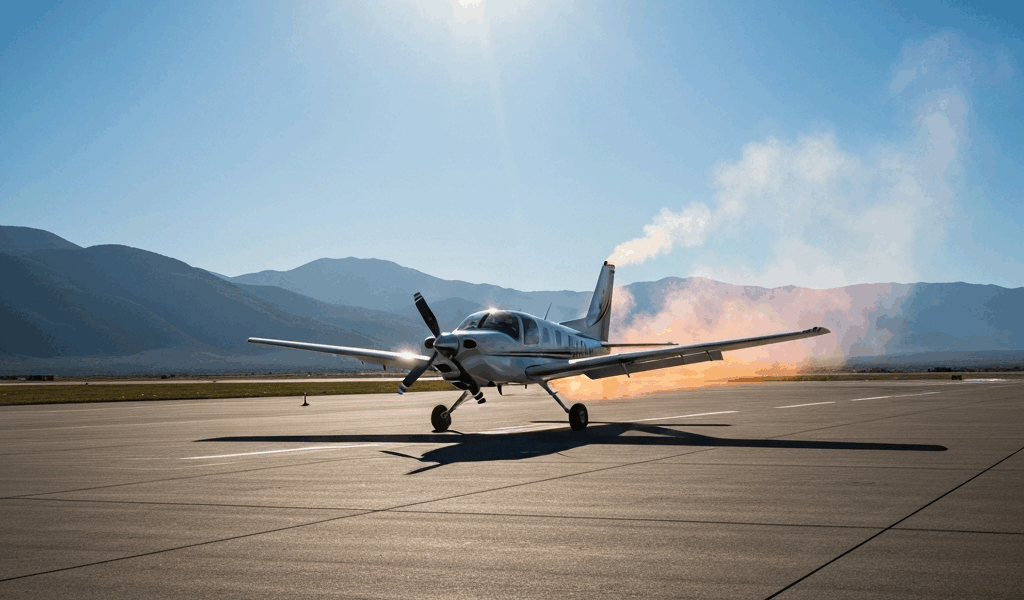
Density altitude has gotten complicated with all the misconceptions flying around. As someone who’s logged over 400 hours in various general aviation aircraft, I learned everything there is to know about this the hard way—felt that sinking feeling when a Cessna 172 that should leap into the air instead wallowed down a runway like it was loaded with concrete. The problem wasn’t the airplane. It was density altitude, though I didn’t know to call it that on my first high-elevation, hot-day departure.
Density altitude affects the aerodynamic and propulsion sides of performance: thinner air changes the lift available at a given indicated condition and reduces the output of many engines and propellers. For the underlying model, review how lift, weight, thrust and drag act on an airplane.
But what is density altitude? In essence, it’s the altitude your airplane thinks it’s at based on air density. Not the elevation on your sectional chart. Not what the altimeter reads. The altitude that actually matters for how your engine breathes and how much lift your wings generate.
Here’s the mental picture: Air molecules spread out when temperature climbs or when elevation rises. Both situations thin the air. A standard day at sea level gives you dense air packed with oxygen. A 95-degree day at 5,000 feet elevation — the air feels like you’re at 8,000 feet or higher to your engine and airfoils. That’s density altitude.
The formula lives in every POH and AFM: Pressure Altitude + Temperature Correction = Density Altitude. But forget memorizing numbers. The principle is simple. Hot air is thin air. High elevation is thin air. Combine them and your plane performs like it’s higher than it actually is.
How to Calculate Your Density Altitude Before Flight
You need two pieces of information: field elevation and outside air temperature (OAT). You find the OAT on your ATIS report or AWOS station broadcast — it’s always listed alongside the dew point. The field elevation sits right there on your sectional or in ForeFlight.
Probably should have opened with this section, honestly. Most pilots skip the calculation entirely and then wonder why they’re not airborne yet.
Here’s the walkthrough:
- Get your field elevation. Let’s say you’re departing from a 3,000-foot field.
- Check ATIS or AWOS for OAT. Temperature reads 95 degrees Fahrenheit.
- Use a density altitude calculator — I use the one at boldmethod.com, but any FAA-approved tool works.
That 3,000-foot field on a 95-degree day? Density altitude comes back 5,700 feet. Your airplane behaves as if it’s departing from a runway sitting at 5,700 feet elevation instead of 3,000 feet. The runway length matters. The weight matters. The headwind matters — or the lack thereof matters more.
You can approximate it without a calculator if you remember one rule: every 1,000 feet of elevation adds roughly 600 feet of density altitude on a standard day. Every 15-degree increase above standard temperature adds another 1,000 feet to your DA estimate. It’s rough, but it works when you’re standing in the cockpit without wifi.
Standard temperature drops about 3.5 degrees per 1,000 feet of elevation. At 3,000 feet, standard temperature is roughly 39 degrees Fahrenheit. If OAT is 95 degrees, you’re 56 degrees hot. That’s your DA spike right there.
Why Your Takeoff Roll Doubles on Hot Days
I pulled open a Cessna 172R POH one July afternoon at Denver Executive Airport. The takeoff performance table showed everything clearly. At sea level on a standard day with calm wind, that 172 needed 1,200 feet of runway to clear a 50-foot obstacle.
Same 172. Same weight. Density altitude was 7,500 feet that day — required runway distance jumped to 3,500 feet.
Why? Physics. Thin air produces less lift. Less lift means the wing develops lower vertical force per unit of time — lower vertical force means you stay on the ground longer accelerating. Longer ground roll. That’s it.
The engine also feels the density altitude hit. Thinner air means fewer oxygen molecules flowing into the carburetor. Your 180-horsepower engine might deliver 160 effective horsepower when DA is high. Same propeller, less bite, slower acceleration.
The numbers shock people when they see them side-by-side. A Piper Cherokee 140 that needs 1,050 feet at sea level on a standard day might need 2,100 feet at 5,000-foot density altitude. A Beechcraft Baron 58 jumps from 1,650 feet to 3,200 feet. These aren’t theoretical numbers — these are POH numbers from actual aircraft performance testing.
Runway length becomes your limiting factor fast. If you’re planning a departure from a 4,000-foot runway and your density altitude climbs to 6,000 feet, you’re not leaving with a full load. Period. The airplane physically won’t get airborne within the available distance.
Density Altitude and Go No-Go Decisions
This is where density altitude stops being academic and becomes a safety decision.
You’re at a remote strip with a 4,000-foot runway. Field elevation 3,500 feet. OAT 88 degrees. Density altitude calculates to roughly 6,100 feet. Your airplane needs 2,800 feet to get airborne at that density altitude with your current weight and fuel load. You’ve got runway. You depart.
But here’s the part nobody talks about: that’s your best-case scenario. No obstacle clearance margin. No safety buffer. No room for an engine failure decision. Add 500 pounds of cargo and suddenly you need 3,300 feet — add a light headwind instead and you get 2,600 feet back. Without headwind? You’re marginal.
The NTSB tracks density altitude involvement in GA accidents. It shows up in every season but peaks in summer, especially at higher-elevation airports. Most accidents involve pilots who calculated correctly but departed anyway thinking they’d make it work. Or pilots who didn’t calculate at all.
The POH tables solve this. Your Pilot’s Operating Handbook contains density altitude performance charts. You enter your aircraft weight and density altitude and read the runway required. If required runway exceeds available runway, you don’t go. Weight, fuel, passenger, cargo — reduce something until the numbers work or find a longer runway.
There’s a secondary issue at high density altitude: carburetor icing risk actually increases. Dense air carries more moisture. That moisture can freeze in the carburetor venturi even on dry, hot days. Use carburetor heat on final approach at high DA. It sounds counterintuitive, but moisture and temperature — not just cold air — trigger carb ice.
Quick Checklist Pilots Use Every Flight
You don’t need to memorize every factor. You need to ask three questions before every hot-day or high-elevation departure:
- What’s my density altitude? Elevation plus temperature correction — calculator or rough estimation. Pick a number.
- What does the POH say I need? Go to the takeoff distance table in your manual. Find your aircraft weight, density altitude, wind component — read required runway distance.
- Do I have it? Available runway minus required runway equals your safety margin. Zero margin means no-go. Negative margin definitely means no-go.
One more question for marginal conditions:
- What am I carrying? If required runway is close to available runway, weight becomes critical. Can you leave a passenger, fuel, baggage, or cargo behind? Does that shift your DA calculation favorably?
The mental checklist is faster than you’d think once you’ve done it three times. OAT from ATIS. Elevation from sectional. Rough DA estimate using that 600-feet-per-1,000-elevation and 1,000-feet-per-15-degrees-hot rule. POH table lookup. Decision made.
Write it down before you push the throttle forward. Literally write: “DA 6,200. Required 2,600 feet. Available 4,500 feet. Margin 1,900 feet. Go.” A simple note on your flight plan proves you thought it through if something goes wrong. More importantly, the act of writing forces your brain to process the numbers instead of rationalizing away a bad decision.
Density altitude kills airplanes quietly. Not because the airplanes fail — because pilots underestimate how much thinner air at 95 degrees changes everything about how their airplane flies. Calculate it. Use the POH. Respect the margin. That’s the operational difference between a routine departure and an accident waiting for runway.


Stay in the loop
Get the latest aviation news updates delivered to your inbox.