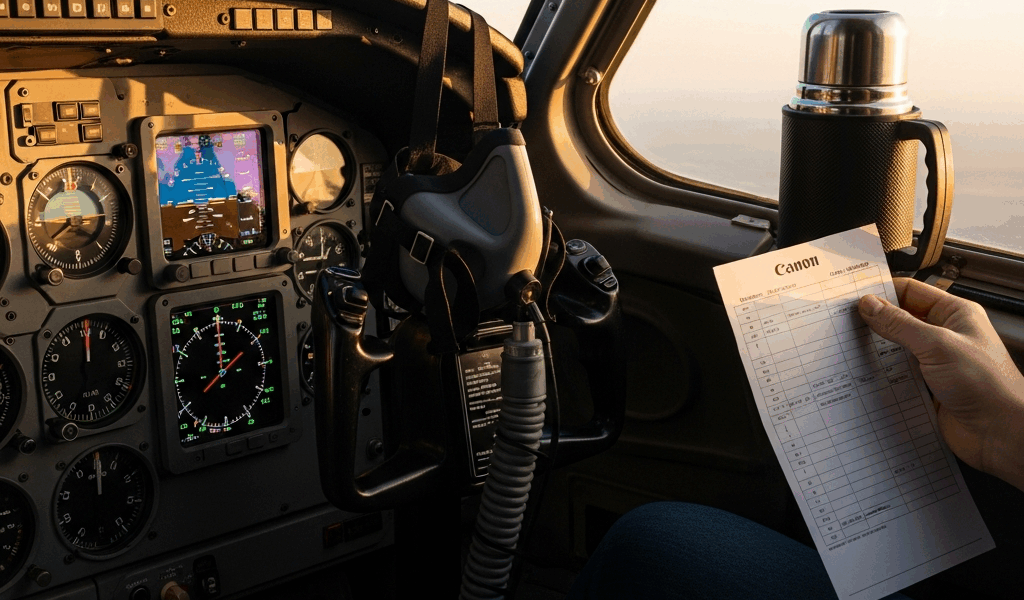
What Hypoxia Actually Feels Like at Different Altitudes
I’ve logged enough training sorties to recognize that hypoxia doesn’t announce itself like engine failure. It whispers. Then it lies to you about whispering.
At 8,000 feet, most pilots feel nothing — that’s the trap. Your body’s oxygen saturation drops to around 93%, but you’re still functional. So functional that you convince yourself the altitude poses no real threat. I’ve watched students fixate on landing gear checks while their cognitive processing has already begun its subtle decline. Memory becomes sticky. You forget what you were about to do mid-task. Your fingers might tingle slightly, a sensation you’ll blame on a tight grip or the cold rather than arterial oxygen tension.
Push to 10,000 feet and decision-making softens. Not dramatically—nothing catastrophic yet. But the gap between good judgment and acceptable judgment narrows. Your blood oxygen saturation sits near 90%. Visual acuity dulls slightly; peripheral vision contracts. A pilot I trained with described it as “looking through a slightly dirty windscreen.” Headache starts creeping in for some people. Others report mild euphoria. Probably should have opened with this section, honestly — because this is where most private pilots encounter hypoxia, and most aren’t carrying supplemental oxygen.
At 12,000 feet, oxygen saturation drops to roughly 83%. Coordination deteriorates measurably. Fine motor skills — the ones you need for precise instrument scanning or smooth control inputs — become sluggish. Reaction time increases. Your speech might slur slightly without you noticing it. Some pilots report a creeping sense of detachment, as if watching themselves from outside the cockpit. Blue lips and fingernails may appear, though skin tone variation makes this an unreliable indicator.
14,000 feet brings saturation to approximately 80%. Impaired judgment is no longer subtle. A pilot at this altitude without supplemental oxygen will overestimate their capability, misread instruments, and rationalize poor decisions with alarming confidence. This is where federal regulation kicks in for commercial operations — not because it’s a hard boundary, but because the risk multiplies exponentially.
16,000 feet and above: cognitive function degrades rapidly. Memory loss accelerates. Thinking becomes rigid. A pilot I knew pushed to 17,500 feet in an unpressurized aircraft and couldn’t remember whether he’d already filed a position report. His logbook was right in front of him.
Here’s the uncomfortable truth — individual variation is enormous. A 22-year-old endurance athlete at 12,000 feet might maintain sharper thinking than a fit 45-year-old. Sleep deprivation the night before, dehydration, caffeine, even anxiety level — all of these shift your tolerance lower. The symptom checklist you memorized for the written exam won’t match what you actually experience.
Why Pilots Miss the Warning Signs Until It’s Too Late
Hypoxia has a psychological component that pure physiology can’t explain. Your hypoxic brain is the one evaluating your hypoxic symptoms. It’s a recursive trap.
Back in the 1980s, the FAA conducted a study. They put non-pressurized aircraft pilots in a chamber and took them to 25,000 feet without supplemental oxygen. Researchers asked pilots to recognize their own impairment. The results were damning. Pilots consistently overestimated their ability, underestimated their symptoms, and made catastrophically poor decisions while convinced they were performing normally. Some pilots refused to acknowledge they were impaired even after researchers pointed out their slurred speech and inability to solve simple arithmetic.
The euphoria trap is real. You don’t feel sick. You feel relaxed. Fine. Better than fine — almost pleasant. Stress melts away. Fatigue vanishes. This can feel like you’ve finally found your altitude sweet spot, when actually your brain is beginning to starve. A pilot experiencing this sensation is less likely to descend, not more likely. Confidence increases precisely when competence decreases.
Some pilots report tunnel vision — literally and figuratively. Visual field narrows. Then mental field narrows. Once hypoxia clouds your judgment enough, you’ve already decided the symptoms aren’t serious. Why descend? You feel fine. You’re maintaining altitude. The numbers on the altimeter look correct — they are, hypoxia doesn’t cause spatial disorientation the way vertigo does. So you keep climbing.
Denial is the sneakiest symptom. I’ve heard pilots say, “Hypoxia? That happens to people who don’t prepare. That won’t happen to me.” That’s hypoxia talking, except the pilot still believes it’s their own rational thought.
The insidious part: by the time symptoms become obvious enough that even hypoxia can’t hide them from your hypoxic brain, you may be minutes away from loss of consciousness. Cognitive impairment progresses in hours, but unconsciousness — that happens fast once you cross certain thresholds.
Oxygen Requirements by Pilot Certificate and Altitude
Federal Air Regulation Part 61 and Part 91 create different rules based on certificate type, which confuses most pilots I know.
Commercial pilots operating unpressurized aircraft must use supplemental oxygen continuously above 14,000 feet mean sea level. Between 12,500 and 14,000 feet, they can operate up to 30 minutes without supplemental oxygen — though why you’d choose to remains unclear. Above 15,000 feet, passengers must receive supplemental oxygen too (14 CFR 91.211).
Private pilots face the gray zone. No regulation mandates oxygen use at any altitude in unpressurized aircraft operated under Part 91. You could legally climb to 17,000 feet in a Cessna 172 and breathe ambient air with zero oxygen supplementation. This is the regulatory gap that kills pilots.
Some states and flight schools impose their own rules — many require oxygen above 10,000 feet. Many don’t. Check your training environment’s standards because the FAA won’t enforce stricter requirements at that certificate level.
For pressurized aircraft, different rules apply based on cabin pressurization altitude. If your cabin pressure altitude exceeds 25,000 feet, you need supplemental oxygen. The specifics vary by aircraft type and pressurization system certification.
Practically speaking: carry supplemental oxygen in any unpressurized aircraft above 10,000 feet if you’re serious about safety. Regulation is the floor, not the ceiling.
Prevention Tactics That Work Better Than You Think
Hydration is the unsexy foundation. Dehydration exacerbates hypoxia symptoms — your blood viscosity increases, oxygen transport becomes less efficient. I started drinking 16 ounces of water the morning of any high-altitude flight. Cost: almost nothing. Effect: measurable.
Sleep quality matters more than sleep quantity. Six hours of genuine sleep beats eight hours of fragmented sleep for altitude tolerance. One bad night cuts your margin. I made the mistake once of flying to 14,000 feet after sleeping only four hours due to family chaos. My decision-making felt foggy at an altitude where clarity matters most.
Gradual altitude climbs — not mandatory, but wise. Spend 15 minutes at 8,000 feet. Another 15 at 10,000. Your body won’t acclimatize in 30 minutes, but your awareness of your own symptoms will sharpen. You’ll notice the subtle signs before they become serious.
Pulse oximetry changed my approach entirely. A basic finger pulse oximeter costs $25–$40. Knowing your actual blood oxygen saturation removes guesswork. At 12,000 feet, I was surprised to read 82% — lower than I expected. That number made the risk tangible rather than theoretical.
Hypoxia training chamber experience — offered by military training commands and some civilian medical facilities — costs $500–$2,000 for a half-day program. You breathe progressively thinner air while an instructor monitors vital signs. You experience your own symptom progression in a safe, controlled environment. This strips away the denial layer. Every pilot I’ve met who completed chamber training became more conservative about altitude afterward. The abstract threat becomes personal memory.
Portable oxygen systems for unpressurized general aviation aircraft run $400–$1,200 installed, depending on duration capacity. A basic system supporting four hours of flight costs less than two dual flight hours. The math is simple.
When to File for Oxygen and Stop Pushing Altitude
Decision framework: if you feel fine at your current altitude, climb 2,000 feet and reassess in five minutes. If symptoms emerge — headache, tingling, mild confusion, visual changes — descend immediately to the previous altitude. Your body just told you where your personal threshold lives.
Never rationalize lingering symptoms. Tingling in the extremities isn’t cold. Mild headache isn’t dehydration, or it might be, but it’s also hypoxia. Difficulty concentrating isn’t fatigue. These are your organs asking for oxygen.
If supplemental oxygen system fails, descend to 10,000 feet minimum, ideally 8,000 feet. Don’t continue climbing. Don’t maintain altitude and “see how you feel.” Descend immediately. A pilot who continued to 16,000 feet after his oxygen regulator stuck open lost decision-making capability and nearly landed at a wrong airport because he couldn’t remember his destination.
Weather pressure systems create false confidence. A high-pressure system can make 13,000 feet feel higher than it is because barometric pressure is lower, but your actual altitude is the same. Check density altitude — that’s what matters physiologically.
If you’re flying a non-owned aircraft or rental, verify the oxygen system before takeoff. Check cylinder pressure, regulator function, and mask fit. A system charged to 1,800 PSI looks full but might only provide 45 minutes of flight. Calculate conservatively.
Hypoxia recognition training isn’t optional for serious pilots. It’s uncomfortable. It exposes your own vulnerability to a threat you can’t see, taste, or smell until it’s too late. But that discomfort is the price of honest self-assessment at altitude.
The altitude where hypoxia becomes dangerous isn’t the same for everyone. It’s not even the same for you on different days. Respect that variability, carry oxygen in any questionable situation, and descend when your body whispers. Your brain will thank you later — assuming your brain is still getting enough oxygen to think clearly.


Stay in the loop
Get the latest aviation news updates delivered to your inbox.