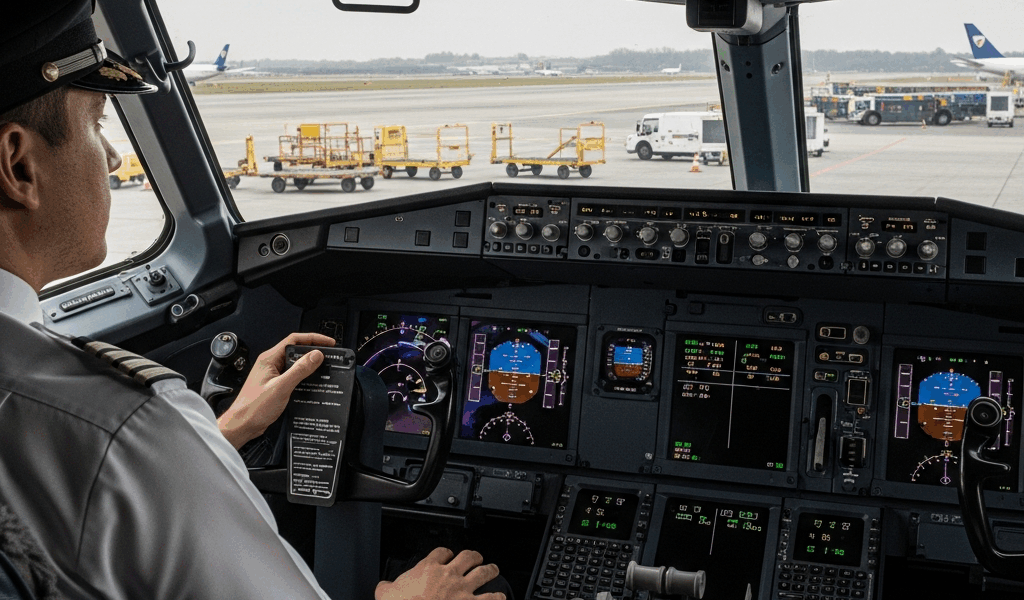
On Friday, July 24, 2026, the FAA will issue a final rule requiring upgrades or replacements of approximately 58,600 radio altimeters across U.S. commercial, business, and general aviation fleets. The move establishes minimum performance standards for aircraft radio altimeters to operate safely as 5G wireless signals expand into the Upper C-band—and it’s coordinated with the FCC’s July 22 spectrum auction decision. The estimated cost: $4.5 billion.
The final rule applies to all aircraft with radio altimeters operating in U.S. airspace and sets up a two-tier compliance structure. Part 121 and Part 129 carriers operating aircraft with 30 or more passenger seats or payload capacity exceeding 7,500 pounds must complete upgrades by the end of 2030. Everyone else has approximately two more years after that.
Scale of Aviation Impact
U.S. airlines alone will need to replace or upgrade 17,033 radio altimeters. The FAA estimates the mandate affects only a minority of general aviation aircraft—many of which don’t have radio altimeters at all. In March 2026, Airlines for America, the Regional Airline Association, the Aerospace Industries Association, and manufacturers including Boeing, Airbus, Collins Aerospace, Embraer, Honeywell, and Thales jointly signaled that the accelerated timeline is achievable with proper financial incentives and cost reimbursement programs.
“The timelines proposed will be challenging in light of solutions that haven’t yet come to market,” said Heidi Williams, vice president of air traffic services and infrastructure at the National Business Aviation Association, in January 2026 comments on the proposed rule.
Technical Requirements and Safety Drivers
The rule establishes next-generation interference-tolerance performance standards for radio altimeters operating between 0 and 500 feet above ground level in the proposed 5G interference environment. These standards ensure altimeters continue providing accurate height-above-terrain data as wireless carriers deploy services in the 3.98–4.2 GHz Upper C-band spectrum—immediately adjacent to the 4.2–4.4 GHz band used by civil aviation radio altimeters.
When radio altimeters fail under 5G interference, aircraft systems depending on that data may not operate as designed. Thrust reversers, spoilers, speedbrakes, and automated landing functions are all at risk. The FAA has identified runway excursions as a primary safety concern, alongside longer landing distances and delayed rejected-takeoff performance—particularly in low-visibility operations.
The danger became urgent on July 1, 2026, when Canada substantially reduced Lower C-band protection mitigations including airport exclusion zones and elevation masks. The FAA responded by issuing Airworthiness Directives effective that date prohibiting non-upgraded aircraft from conducting lowest-visibility approaches and automated landings in Canadian airspace.
Regulatory and Industry Context
This action stems from the One Big Beautiful Bill Act, signed July 4, 2025, which directs the FCC to auction not less than 100 MHz in the Upper C-band by July 4, 2027. The FCC adopted its Report and Order on July 22, establishing an auction timeline and a radio-altimeter rebate program—dollar amounts to be disclosed post-vote—to incentivize operator compliance.
RTCA SC-239 and EUROCAE WG-119 are developing the new performance standard. It’s expected in March 2027 following validation testing and public comment. Wireless carriers can commence Upper C-band services in December 2030 in the 75 largest U.S. markets, with the rest of the country following in July 2031.
“The FAA regulation provides technical and schedule certainty to potential 5G auction bidders, and the FCC requirements for a radio-altimeter rebate program will provide financial incentives for the aviation community to hold to the altimeter-upgrade schedule,” the FAA stated Wednesday.
This isn’t the first time. The FAA issued a prior altimeter upgrade mandate in 2023 for Lower C-band interference mitigation, which the entire U.S. airline fleet completed by September 2023. Upper C-band upgrades represent a larger and more expensive retrofit cycle across a broader aircraft population.
Sources
- FAA Newsroom — Press Releases
- Federal Register — Docket No. FAA-2025-5666 (NPRM, January 5, 2026)
- Federal Register Vol. 91, No. 125 (June 30, 2026)
- FCC Report and Order (July 22, 2026)
- Airlines for America Industry Letter to FCC Secretary Marlene Dortch (March 26, 2026)



Stay in the loop
Get the latest aviation news updates delivered to your inbox.