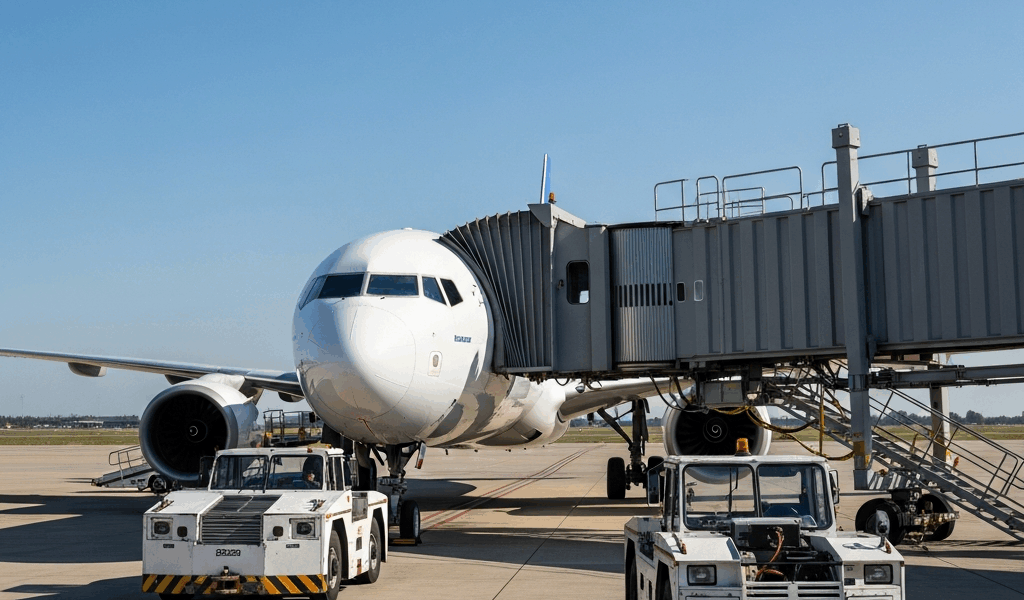
Boeing’s landmark 200-aircraft order from China—valued at $17 billion to $19 billion and announced on May 20, 2026, following meetings during the Trump-Xi Beijing summit in May 2026—is in danger of falling apart. The sticking point: engine parts and post-sale maintenance terms.
Long-term support agreements depend on more than parts availability: approved capability, technical data, records, shop capacity and return-to-service authority all matter. Our aviation MRO services guide explains those maintenance, repair and overhaul controls.
According to reporting by Politico citing people familiar with the negotiations, the real dispute centers on long-term maintenance, repair, and overhaul (MRO) obligations and component supply-chain guarantees. China’s Ministry of Commerce stated in May that the U.S. government had committed to providing “strict supply guarantees” for aircraft engine parts and components as part of the agreement. The White House has since pushed back, claiming that post-sale maintenance was never included in the original $17 billion to $19 billion deal framework.
The breakdown is significant. For Chinese carriers operating a fleet of 200 or more narrowbody and widebody aircraft, guaranteed access to engines and components for two to three decades is essential to fleet viability—placing operators at potential risk if future U.S. policy restrictions limit exports to China. Long-term engine support and spare parts availability have become central to the negotiations.
Beijing’s fears are not abstract. In May 2025, China faced temporary sanctions on critical aviation technology, including CFM International LEAP-1C engines for the Comac C919 and GE Aerospace CF34 engines for the C909, along with components from Honeywell Aerospace and Collins Aerospace. The licenses were reinstated by July 2025, but the episode underscored just how vulnerable Beijing is to supply disruptions.
Boeing CEO Kelly Ortberg joined U.S. executives in a May 14 meeting with Chinese Premier Li Qiang in Beijing. The announcement of China’s commitment to the 200-aircraft order came on May 20, 2026, from China’s Ministry of Commerce and Trump administration officials. Boeing has not issued its own formal statement confirming deal terms. Ortberg has characterized the 200-jet order as an initial tranche. Reports suggest China intends to acquire several hundred additional aircraft in subsequent stages, potentially reaching 700 units.
The specific aircraft types in the 200-jet order have not been publicly disclosed. Industry deals illustrate the significance of engine maintenance contracts. Singapore Airlines’ 2022 order for 22 GE9X engines, paired with a 12-year maintenance contract, totaled $2.8 billion at list price. Korean Air’s multi-year MRO agreement with GE Aerospace for 62 GE9X engines—supporting its Boeing 777X fleet—is part of a broader $36.6 billion fleet renewal program. Emirates committed to two separate engine deals: an initial 2013 purchase of 300 engines valued at approximately $16 billion, followed by an additional 2015 MRO contract valued at $16 billion for 12-year maintenance, repair, and overhaul support.
Timing matters. The 777X program has faced repeated delays and cost overruns exceeding $15 billion. Kelly Ortberg confirmed in October 2025 that first deliveries are now expected in 2027. Launch customer Lufthansa anticipates its first 777-9 in summer 2027, pending FAA type certification in the second half of 2026. The program currently carries over 620 firm orders, including recent commitments from Korean Air and Air India.
As of July 25, negotiations between Boeing, China, and GE Aerospace remain ongoing. No resolution or formal deal signing has been announced. The question now is whether the dispute will be resolved or whether the first major Boeing-China commercial aircraft order in a decade will collapse over supply-chain economics.
Sources
- Simple Flying Aviation News
- Politico (reporting on China-Boeing negotiations, July 2026)
- China Ministry of Commerce (official statement, May 20, 2026)
- Boeing earnings and investor relations statements
- GE Aerospace press releases and investor communications


Stay in the loop
Get the latest aviation news updates delivered to your inbox.