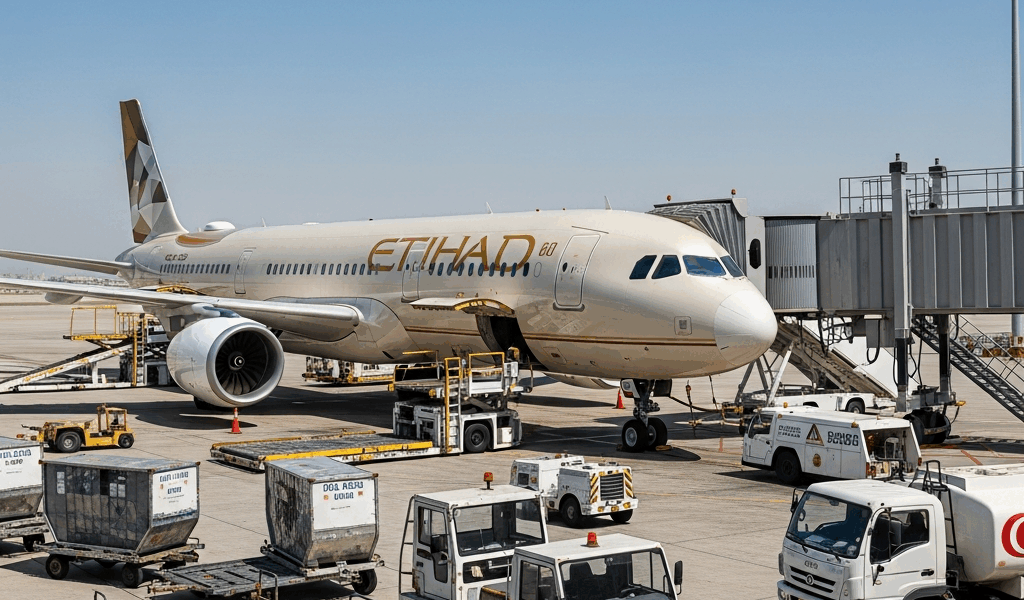
Etihad Airways Doubles Abu Dhabi–Kabul Service to Two Daily Flights
Etihad Airways is doubling down on its Afghanistan expansion. The carrier will increase daily frequency on its Abu Dhabi–Kabul route from one to two flights starting July 15, 2026, the airline announced on June 10, 2026. Since launching the route in March 2026 with four weekly frequencies using Airbus A320 aircraft, demand has outpaced expectations.
The move signals rapid market recovery in Afghanistan’s commercial aviation sector and establishes Abu Dhabi as a key regional gateway. Each A320 carries 8 Business Class and 150 Economy Class seats—158 seats per flight. By doubling frequency, Etihad will add approximately 316 daily seats in each direction.
“The response to our Kabul launch has been exceptional,” said Arik De, Etihad’s Chief Revenue and Commercial Officer. “Demand has remained strong from day one, and moving to double-daily is a direct reflection of what our guests have been telling us with their bookings. This rapid expansion is another example of the strategic approach we take to network development, allowing us to respond quickly to the wishes of our guests, and strengthening Abu Dhabi’s role as an important gateway connecting regional markets with our global network.”
At roughly 3.5 flight hours, the Abu Dhabi–Kabul route falls comfortably within the A320’s range.
Why Now?
Multiple demand drivers are at play. Afghanistan hosts one of the Gulf region’s largest diaspora communities—substantial Afghan populations live throughout the UAE. Business travel has also rebounded as commercial aviation normalizes across the region, with both corporate and leisure segments fueling the route’s performance.
The expansion fits within Etihad’s broader 2026 network push. This summer alone, the airline is launching 14 new routes, including Hong Kong, Hanoi, and Dhaka on widebody jets, plus regional A320 services to Damascus and Medina. In 2025, Etihad received 19 aircraft—a company record—with additional aircraft scheduled for 2026 and further deliveries planned through 2028.
Etihad is moving faster than competitors. Emirates and Qatar Airways have not announced Kabul service for summer 2026, according to available schedule data. Afghan flag carrier Kam Air is expanding to Istanbul, Doha, Dubai, Jeddah, Medina, New Delhi, Tashkent, and Almaty in 2026—but lacks the hub infrastructure Gulf carriers possess for long-haul connections.
The Operational Picture
Kabul International Airport sits 5 kilometers northeast of the capital at 1,791 meters elevation. Its single 3,500-meter runway handles large commercial jets despite challenging terrain. Jointly operated by UAE-based GAAC Holding and Afghanistan’s Ministry of Transport and Civil Aviation, the airport now operates around the clock.
The broader environment carries constraints worth noting. Afghanistan’s flight information region remains uncontrolled Class G airspace with no air traffic services. Pilots maintain their own separation, and approach control at major airports frequently goes offline. Etihad’s twice-daily service demonstrates confidence in crew training and operational procedures for these specific conditions.
What’s Next
Etihad has not announced further frequency increases or additional aircraft on the Kabul route. The airline will continue expanding its network as fleet deliveries progress.

Stay in the loop
Get the latest aviation news updates delivered to your inbox.