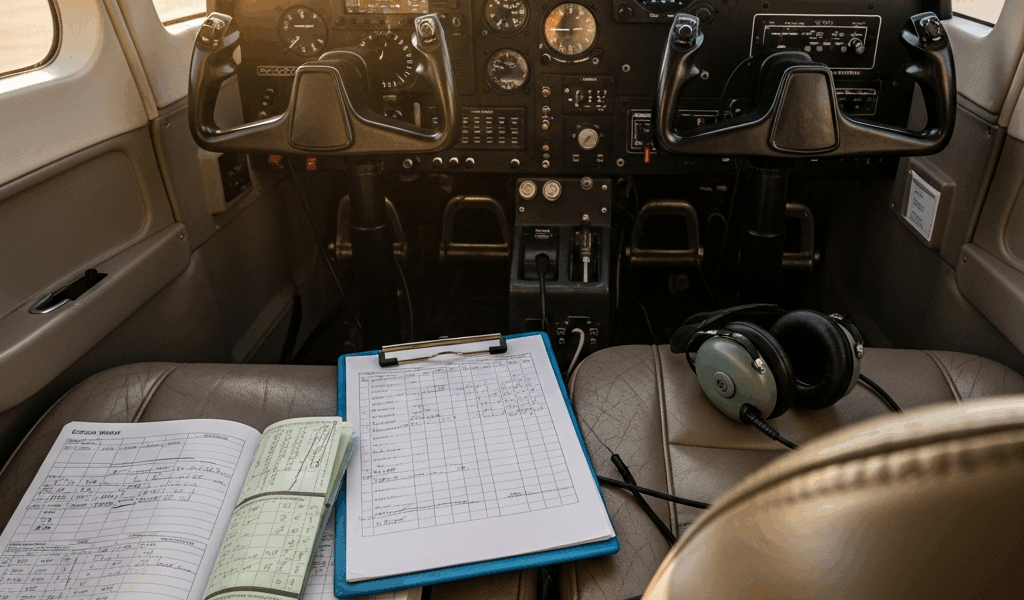
Your CFI Decides — Not the Logbook
Solo endorsement has gotten complicated with all the misinformation flying around. Ask ten student pilots what the hour requirement is, and you’ll get ten different answers. Forty hours. Fifty. Maybe sixty if your instructor is particularly cautious. Here’s what none of them will tell you: there is no hour requirement in 14 CFR 61.87. Zero. Not one.
Your CFI holds all the cards. Not the FAA. Not your logbook total. Your instructor.
I learned this the hard way. Convinced I needed to stack hours the way you’d fill a tank — measurable, metric-driven, predictable — I kept watching my logbook like it owed me something. My instructor said “not yet” somewhere around hour 35, and I genuinely thought I was failing. I wasn’t. He was watching for something that hadn’t clicked: I could execute maneuvers, but I wasn’t thinking three steps ahead. The moment that changed, the endorsement came. Hour 37. That was it.
The regulation gives your CFI complete discretion. That should feel reassuring — at least if you stop thinking of training as a transaction. Your instructor isn’t running a checklist against your logbook. They’re watching you fly. They want you up there alone safely, and they’re not hunting for reasons to hold you back. They’re looking for readiness. Understanding what readiness actually means to them changes everything.
The 15 Maneuvers You Must Demonstrate
14 CFR 61.87(d) lists 15 specific maneuvers your CFI must see before endorsing you. Most articles just dump the list and move on. That misses the point entirely.
Ground Operations and Basic Control
Preflight, engine start, taxi, takeoff. Sounds like the easy part. It isn’t. Your CFI isn’t watching you go through motions — they’re watching whether you catch things. Miss a loose cowl latch during preflight and that’s a red flag, full stop. On taxi, can you keep the nosewheel tracking the centerline without wandering? Sounds trivial. It’s not. Sloppy ground habits tend to show up again at altitude, usually at the worst possible moment.
Airwork and Handling
Straight-and-level, climbs, descents, turns. Basic stuff, yes. But your CFI is watching trim discipline specifically. Are you muscling the yoke through every maneuver, or are you trimming? Are your turns coordinated, or are you slipping through them? During slow flight, altitude within 100 feet — that’s the standard, and it’s tight on purpose. Precision in slow flight builds the habit that saves you in a crowded traffic pattern.
Stalls hit different than people expect. Recovery isn’t just knowing to reduce angle of attack — any textbook covers that. What your CFI is evaluating is your composure when the wing actually lets go. Nose pitching down, controls going soft. Can you stay calm and execute? Do you recognize buffet before it becomes a full break? This one maneuver tells your instructor more about how you’ll handle a real emergency than almost anything else.
Traffic Pattern and Landing
Ground reference maneuvers — turns around a point, S-turns, rectangular course. These demand divided attention: wind correction, altitude, bank angle, ground track, all simultaneously. Your instructor is watching whether you’re actively correcting for wind drift or just hoping the airplane cooperates. Hope is not a technique.
Approaches and landings are where everything converges. Full stop, short field, soft field — each one is an energy management problem. Too many students float halfway down the runway or dive steeply at the numbers. Neither works for solo. Consistency is what your CFI needs to see, not one perfect landing surrounded by five mediocre ones.
Emergency Procedures
Engine-out glide, emergency descent, forward slip. These are non-negotiable. Engine failure on climbout gives you roughly three to five seconds to decide whether you have enough runway ahead or need to land somewhere else entirely. Your instructor needs to see that decision happen fast and correctly — not after a long pause and a hopeful look at the gauges.
Medical and Student Certificate — Get These First
Probably should have opened with this section, honestly. I’ve watched students show up confident they were weeks from solo, only to realize their medical was still sitting in a pile at the AME’s office.
Before your CFI can legally endorse you, you need two things in hand: a valid student pilot certificate and at least a third-class medical. The student certificate comes from the FAA after your knowledge test and medical are squared away. Get both before you start counting down to solo.
The medical is not a rubber stamp. A third-class screens for conditions affecting judgment, motor control, and stamina — diabetes, heart arrhythmias, certain medications, depression under treatment. Any of these can trigger a denial or a Special Issuance process that takes months. If you have anything you’re unsure about, call an Aviation Medical Examiner before booking your appointment. A consultation runs roughly $50–$150. That’s cheap compared to showing up, failing, and losing the non-refundable exam fee while you sort out paperwork.
BasicMed exists as an alternative — at least if you meet the criteria. You need a medical issued within the past 10 years, you’re flying a single-engine piston under 6,000 pounds, and you complete an FAA-approved online course. Not every student qualifies. But if you do, it’s genuinely simpler than dealing with a traditional third-class renewal. Don’t make my mistake of not looking into it earlier.
What the Pre-Solo Written Test Actually Tests
Buried in 14 CFR 61.87(b) is a requirement a surprising number of students gloss over: your CFI must administer and personally review a written test before your solo. Not the FAA knowledge test. A test your CFI writes themselves.
But what is this test, exactly? In essence, it’s an aircraft-specific and airspace-specific quiz. But it’s much more than that — it’s your instructor confirming you actually know the machine you’re about to fly alone.
Training in a Cessna 172S? Expect questions about the fuel system — usable gallons per tank, fuel selector positions, what happens if you run one tank dry. Electrical system questions. Engine management. Then local airspace: where does Class B begin overhead, what’s the ATIS frequency, what are the noise abatement procedures off Runway 28. Real questions with specific answers.
Typical examples: “What is the maximum landing weight of this aircraft?” “How many gallons of usable fuel are in the left tank?” “What frequency does ground control use here, and when do you switch to tower?” “Describe your go-around procedure if the landing looks unstable at 100 feet AGL.”
It’s closed-book. That matters. Your CFI is checking whether this information lives in your head — not whether you can locate it in the POH while the runway threshold is approaching.
Common Reasons Solo Gets Delayed and How to Fix Them
You’ve demonstrated the maneuvers. You’ve passed the written. Your medical is current. Your CFI still won’t sign you off. Here’s what’s actually happening — and what fixes it.
Inconsistent Altitude in the Traffic Pattern
You’re hunting altitude on downwind. Up 200 feet, down 150, oscillating around 1,000 feet AGL instead of holding it. Your CFI needs to see you nail and hold pattern altitude, not chase it every lap. Ask for a session that’s nothing but pattern work — ten laps, no other agenda. Establish a trim setting that works for your weight that day, use small inputs, and resist the urge to overcorrect. Precision builds faster than you’d expect once you stop reacting to every deviation with a big correction.
Rushed or Incomplete Checklists
You’re calling items without actually verifying them. “Fuel pump, on” while your eyes are somewhere else. Your CFI hears it. Touch the switch. Confirm the position. Verbalize it out loud and mean it. “Flight controls — free and correct.” This is not busywork — it’s the habit that keeps you alive when workload spikes and your brain starts skipping steps automatically.
Passive Radio Communication
You’re keying up without a plan, or you’re mumbling through your calls. Ground asks a readback question and you freeze. I’m apparently a slow radio learner, and the Cessna’s push-to-talk button works for me while trying to talk and fly simultaneously never worked until I drilled it on the ground first. Write out your calls. Say them out loud sitting in your car. Record yourself on your phone and listen back — it’s uncomfortable and useful. Once radio becomes automatic, the mental load in the pattern drops noticeably.
Late or Unstable Flare
You’re floating past your touchdown zone, or you’re landing flat and hard on the mains. A stable approach fixes most of this before you even cross the threshold. If you’re high and fast on final, go around — don’t try to salvage it. Practice picking a specific 150-foot touchdown zone and landing in it consistently. Add a discipline drill: at 100 feet AGL, go around even when the landing looks perfectly fine. It kills the “I’ll make this work” thinking that produces bad landings.
That’s what makes the delay frustrating but endearing to student pilots who’ve been through it — looking back, every hold-up had a reason. Delays are not punishment. Your CFI has endorsed a lot of students. They know what ready looks like. When they wait, they’re protecting you. That’s the job.
So, without further ado — go fly.



Stay in the loop
Get the latest aviation news updates delivered to your inbox.