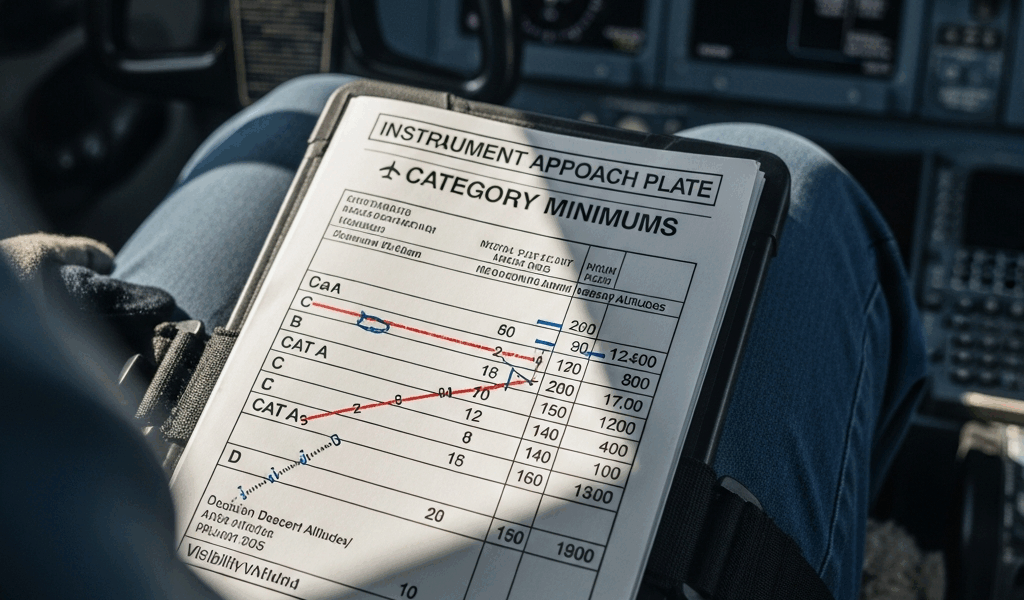
You are planning an instrument approach and the chart says “Category C only” for a certain visibility minimum. But what puts your aircraft in Category C versus Category B? The answer comes from one specific number: your approach speed at max certificated landing weight.
The FAA Definition: What Each Category Means
Aircraft approach categories are defined by 1.3 times Vso (stall speed in landing configuration) at maximum certificated landing weight. The categories and their speed ranges:
Category A: Less than 91 knots — Single-engine pistons, light twins, most training aircraft.
Category B: 91-120 knots — Turboprops, larger twins, regional aircraft like the Dash 8 and ATR 72.
Category C: 121-140 knots — Narrowbody jets. 737, A320 family, most domestic airliners.
Category D: 141-165 knots — Widebody jets, heavy transports. 767, 777, 787, A330, A350.
Category E: Above 165 knots — Military aircraft. Not used in civilian operations.
Why Categories Matter for Approach Planning
The category determines your minimum visibility requirements on instrument approaches, your circling approach minimums, and the protected airspace dimensions around the approach course. Higher categories (faster aircraft) need more room to maneuver and higher visibility to execute an approach safely.
A Category A aircraft flying a circling approach might have 1-mile visibility minimums. The same approach for Category C could require 2 miles. The approach course is the same — the difference is how much room the aircraft needs to transition from the approach to the runway, which is directly related to speed and turn radius.
Circling approaches are where categories matter most. A Cessna 172 (Category A) can circle to land in a much tighter radius than a 737 (Category C). The visibility and obstacle clearance requirements reflect that physical reality.
Can You Use a Lower Category?
Yes, if your actual approach speed qualifies. If you fly a Category C aircraft but your approach speed at actual landing weight falls below 121 knots, you may use Category B minimums — provided you fly the approach at that lower speed. The regulation ties the category to the speed you actually fly, not just the aircraft’s maximum certificated weight.
In practice, most Part 121 operators fly the category assigned to their aircraft type at max landing weight. General aviation pilots with lighter aircraft have more flexibility. A King Air that straddles the A/B boundary might legitimately use either set of minimums depending on actual approach speed.
The Practical Takeaway
Know your aircraft’s approach category. It determines which line on the approach plate applies to you. For airline pilots, the category is set by type and rarely changes. For GA pilots, understanding the speed thresholds lets you use the correct minimums and potentially benefit from lower category requirements when flying at lighter weights.


Stay in the loop
Get the latest aviation news updates delivered to your inbox.