“`html
Why Shallow Water Landings Go Wrong
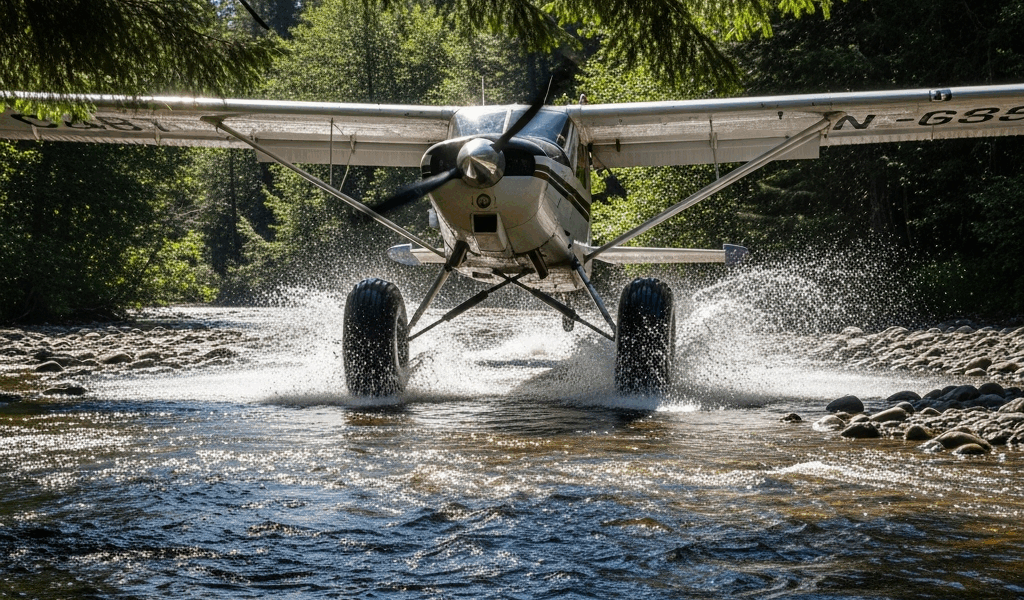
I’ve spent the last eight years operating a Piper PA-18 Super Cub on floats across northern British Columbia, and shallow water crossings in bush flying have gotten complicated with all the variables flying around. Honestly, it remains the single most dangerous operation I perform regularly — not because water landings are inherently unstable, they’re not, but because pilots consistently misread three critical variables before touchdown, and by then, your recovery options vanish fast.
The first failure mode hits you hard: misjudging water density and depth from altitude. You spot what looks like a reasonable landing zone at 500 feet AGL. The water appears flat and dark. You descend. At 200 feet, reality shifts — that “dark” is actually suspended silt and organic matter. The water is four feet deep maximum, maybe two. Your float draft sits at 18 inches. The math becomes unfriendly instantly.
Second, pilots flare too high and drop like a stone. Grass strips condition you to flare aggressively, holding altitude until the last 50 feet. Water demands a different rhythm entirely. Flaring high on floats kills your descent rate too early, leaving you with nothing to cushion the touchdown. I watched a Cessna 206 on amphibious gear do exactly this back in 2019 — pilot held altitude expecting a slow descent, floats touched down at nearly 8 feet per second vertical velocity. The nose gear collapsed on impact. Equipment gone. Pilot walked away, but barely.
Third, there’s hydroplaning into obstacles. You land on what feels like firm water, but the surface layer is moving faster than deeper water. Your floats plane across the top, spray column blocks your vision entirely, and suddenly there’s a deadfall log 40 feet ahead. Probably should have opened with this section, honestly — it’s the most visceral failure mode, and it’s completely preventable.
Pre-Landing Reconnaissance Methods
Visual checks begin at altitude, not on approach. Climbing out from your previous landing site, execute a deliberate survey pass at 1,000 feet above the target water. Bank slowly. Look for color transitions, ripple patterns, surface texture — everything tells a story.
Water color tells you depth, and it’s surprisingly reliable once you learn the language. Glacier-fed streams appear milky gray or turquoise — that suspended glacial silt bounces light differently, and depth is often 3 to 8 feet even where it looks shallow. Clear water showing a tan or brown bottom? That’s likely 2 to 4 feet, depending on light angle and the season. Black water, especially under overhanging trees, could be 8 feet or 2 feet. You can’t tell without the low pass.
Ripple patterns reveal current and obstacles in ways nothing else does. Smooth glassy patches indicate slower water and possible eddies where you don’t want to land. Consistent small ripples mean moderate flow and relatively even bottom — that’s your sweet spot. Interrupted ripples, sudden texture changes, or standing waves suggest rocks, logs, or fast current underneath. See concentric ripples spreading from a fixed point? That’s a hazard breaking the surface — log, rock, or submerged stump. Mark it and avoid it.
The low pass is mandatory for shallow water landings. Reduce altitude to 150 feet AGL, extend your approach into a long, gentle descent over the landing area. This pass accomplishes three distinct things. First, you get a clearer view of the bottom contour — at 150 feet, the water surface angle changes, and light refraction becomes far more informative. Second, you’re looking for debris at eye level; deadfall is much more visible at shallow angles. Third, you’re testing for wind. A gentle low pass tells you if turbulence, downdrafts, or crosswind are legitimate factors.
During this low pass, identify your touchdown point with precision. Pick a reference point on shore or an obvious feature in the water. Mark where your floats will first kiss the surface — and here’s the key: don’t pick the middle of a clear patch. Pick a spot 50 feet into it, giving you run-off distance if the water is shallower than expected.
Return to pattern altitude. Plan your second approach with that touchdown point fixed in your mind. Aim for it directly. Don’t adjust late based on the view from closer in; adjustments at 50 feet on floats are commitment decisions, not corrections.
Approach Angle and Speed Control
Shallow water demands a shallower descent angle than grass strips — I’m apparently one of those pilots who obsesses over descent angles, and 3 degrees remains my target, occasionally 4. Steeper approaches cause two immediate problems: they limit your options if the bottom rises suddenly, and they concentrate your descent energy into a narrower window, making flare timing absolutely catastrophic.
Your approach speed needs a buffer that grass strips don’t require. The PA-18 cruises at 100 mph true air speed; I approach water at 45 knots, which is roughly 52 mph true. Grass strips? Forty knots. That extra 2 knots sounds trivial. It’s not. Water creates drag earlier than grass ever does. If you arrive at 40 knots, planning to trade airspeed for descent on floats, you’ll run out of altitude before the flare develops properly. Arriving at 45 knots gives you actual deceleration room.
Common approach speeds fail on water because pilots don’t account for drag initiation — a critical oversight. The moment your floats kiss water, you’re generating drag that a tailwheel or tricycle gear doesn’t experience until touchdown. That’s not a gentle transition. Your descent rate must account for this fundamental difference. Shallower angle, modest speed buffer, and earlier flare preparation all work together to keep you safe.
Flare timing on water happens earlier than grass, period. I begin my flare at 30 feet AGL on grass; on water, I’m already starting the flare at 40 feet. The reason is simple and unarguable: floats don’t have the forgiveness of wheels. A hard landing on grass bends the tailwheel, bounces you around, and you keep flying. A hard landing on water stops your forward momentum instantly and violently. Control the descent rate, or the descent rate controls you.
Abort Decisions and Go-Around Triggers
Five decision points commonly fail to trigger aborts, and I’ve been guilty of each one. I learned these lessons the hard way.
Debris visible at last second. You’re at 50 feet, committed to landing, when you spot a log. Abort immediately. Go around. The urge to salvage the approach is overwhelming, especially if you flew two hours to reach this spot. Ignore that urge completely. A go-around from 50 feet on floats is safe if you’re above stall speed and below redline. It’s dangerous only if you’re already committed to the flare. If you’re still descending at 3 degrees, you have 20 seconds and altitude. Use it.
Unexpected current direction shifts your entire plan. You planned a landing into a subtle current flowing north, but at 30 feet, you realize the flow is stronger than expected and the floats are crabbing hard — too hard. If the crab angle exceeds 10 degrees and you don’t have crosswind capability, abort and circle to land in the opposite direction or find a different approach heading entirely.
Crosswind gust hitting final approach can ruin everything. Thermals off rock faces and treelines create localized wind shear on water that you won’t experience over land. A gust that’s manageable on grass becomes a float-tipping hazard on water. I’ve been knocked 15 degrees off heading by a single gust in tight valleys. If you can’t control heading within 5 degrees of your planned touchdown direction, abort and reposition.
Water surface too rough means wait or find alternatives. Small wave sets aren’t dangerous, but landing in waves taller than six inches risks porpoising — the floats skip across wave crests, and you lose directional control. Abort and wait, or find smoother water downstream.
Excessive spray ingestion risk is real and specific. Landing in cold water with heavy spray creates a scenario where spray reaches your engine air intake. I’ve seen spark plug fouling from salt water spray on Alaska bush runs. If spray is heavy enough to obscure forward vision during touchdown roll, abort without hesitation.
Safe aborts require altitude — this isn’t negotiable. Never plan to abort below 30 feet; you don’t have energy to recover. Never abort with the flare committed; pull the nose up, add power, and climb out cleanly. Dangerous aborts happen when pilots try to level off at 15 feet and climb away — you’ll sink, not climb, and that deadfall is suddenly relevant.
Post-Landing and Takeoff Complications
Once your floats kiss water, the problems aren’t over. They’re just different, and they demand attention.
Water drag on float bottoms consumes power you don’t have sitting still. A PA-18 on floats needs full throttle just to taxi against moderate current. If your landing zone has current, plan your approach to land nose-upstream. This lets you angle toward shore for mooring without fighting water resistance that’ll exhaust you.
Spray ingestion happens during takeoff roll in cold water conditions — a scenario that separates careless operators from survivors. The spray column rises behind your floats, and if your engine air intake is positioned poorly, water enters the carburetor or air filter. Check your intake location before flying to cold water. Some floats, especially older models, have vulnerable designs. Newer Edo floats handle this better. If you’re operating a Piper Super Cub on vintage floats, consider float upgrades for high-altitude or cold-water bush operations. That upgrade might save your engine.
Takeoff distance increases on water by 30-50% compared to grass — I’m apparently one of those pilots who plans conservatively, and it’s never failed me. You need a longer run to generate equivalent speed. If your landing zone is a narrow creek, verify takeoff distance before committing to land. I’ve had to wait two hours for downstream water traffic to clear so I could use 2,000 feet of river for takeoff instead of my original 1,200-foot estimate.
Gear-up emergency landings on water are survivable if flare is controlled and deliberate. Belly landing a wheeled aircraft is less dramatic than it sounds if you’re at the right descent rate. The problem is that gear extends during impact, potentially cartwheeling the aircraft. Amphibious gear collapses reliably — the design accounts for it. Conventional gear does not. If you’re in a fixed-gear aircraft and lose power over water, best option is slow, shallow descent into a flat area with a long flare. Modern aircraft have high glide ratios; you’ll have time.
Don’t make my mistake. I assumed all shallow water crossings were interchangeable — that landing on a river was identical to landing on a lake. They’re not. Rivers have current, limited width, and potential hazards on both banks closing in. Lakes have fetch, sometimes dense weed beds, and water that can be deceptively deep or shallow depending on glacial activity upstream. Recognize the water type before you descend. It changes your technique fundamentally.
“`


Stay in the loop
Get the latest aviation news updates delivered to your inbox.