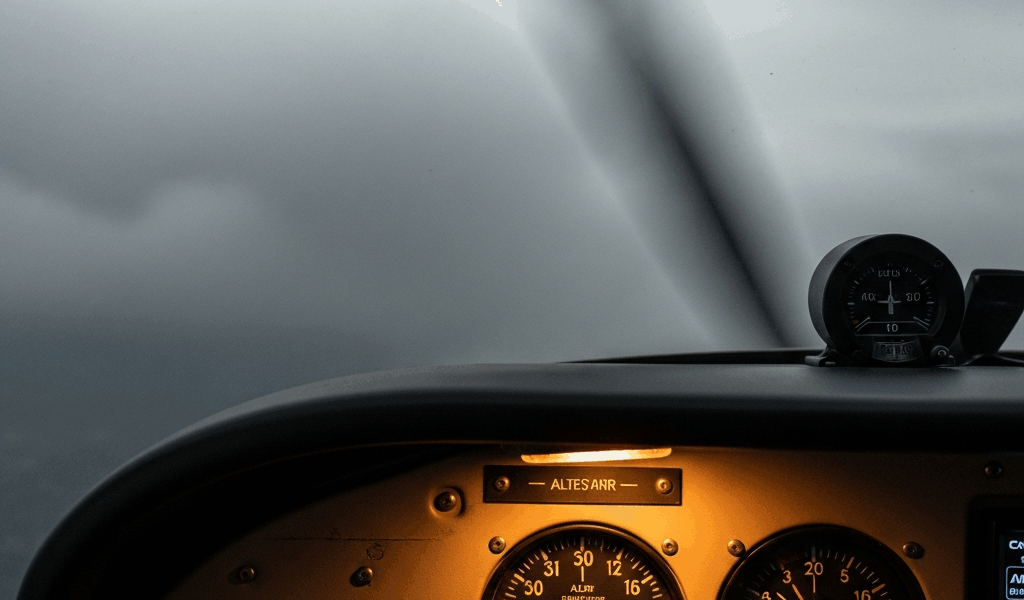
How VFR Into IMC Kills Pilots So Fast
VFR into IMC has gotten complicated with all the myths and half-baked advice flying around. Some pilots treat it like abstract trivia. It isn’t. It’s a decision sequence — and if you botch it, you’ve got roughly 178 seconds before spatial disorientation takes the wheel completely.
As someone who has spent years instructing and watching pilots navigate this exact scenario, I learned everything there is to know about what those final moments actually look like. Today, I will share it all with you.
In 2019, a fellow instructor I knew lost a student — not in the sky, thankfully. The pilot survived. But the situation unfolded exactly the way a thousand NTSB reports describe it: clear morning, “just a quick hop,” clouds stacking up over the ridge. By the time the horizon vanished, the brain had already started lying. That was Tuesday. Ordinary Tuesday.
But what is spatial disorientation? In essence, it’s your inner ear, your eyes, and your proprioception all voting differently about which way is up. But it’s much more than that. The pilot physically feels a left bank while he’s actually 40 degrees into a right turn. Every instinct screams “push the nose down” — the exact input that converts a recoverable situation into fatal wreckage. That 178-second window is real. It’s documented. It’s how long most VFR pilots have before their lying senses overrule their instruments.
This isn’t here to terrify you. It’s here to make you angry enough to actually prepare.
The First 30 Seconds After You Lose Visual Reference
Probably should have opened with this section, honestly. Everything that follows depends on what you do before conscious thought catches up. This is exactly where most pilots freeze solid.
The horizon disappears. Execute this sequence immediately:
- Wings level. Now. Bank angle to zero — not “roughly level,” not “close enough.” Zero. Your attitude indicator shows a small airplane symbol against a horizon bar. That’s your reference. Pitch stays exactly where it was when you last had visual contact outside. Move the yoke forward or back only if pitch has actually changed. A lot of pilots overcorrect here and accidentally start a descent they don’t notice for another 20 seconds.
- Trust the six-pack. Airspeed indicator, attitude indicator, altimeter, turn coordinator, vertical speed indicator, heading indicator. Six instruments. Ignore your body entirely. Your inner ear is lying to you right now. Accept that — completely, without negotiation.
- Reduce power if airspeed is climbing. Most inadvertent IMC entries happen at full cruise power. If you’re watching the needle crawl toward the yellow arc, pull back to around 65 percent throttle. You’re not trying to climb out of anything. You’re stabilizing. Stopping a dive-and-climb oscillation before it snowballs is the entire goal here.
- Call ATC or 121.5. State your position, your altitude, that you’ve lost visual reference, and that you’re flying on instruments. Do this before anything else if you’re near controlled airspace. If you’re somewhere remote, declare anyway — someone will vector you toward VFR conditions or safer terrain. Don’t be shy about it.
- Scan instruments in this exact order: airspeed, attitude, altitude, turn coordinator, heading. Repeat that scan every five seconds. Do not fixate on a single gauge. Fixation — not instrument failure — kills more inadvertent IMC pilots than anything else on this list.
That entire sequence takes roughly 45 seconds if you’ve rehearsed it even a handful of times. Most pilots burn 3–4 minutes and drop 500 feet before they’ve stabilized anything.
Executing the 180 Turn Back to VFR Conditions
Wings level and stabilized — good. Now your priority is almost always getting back to VFR weather. The 180-degree turn is the textbook move for a straightforward reason: it takes you back over terrain you already flew across and survived.
Here’s the mechanical reality most instructors gloss over entirely:
Use a standard-rate turn — 3 degrees per second. A full 180 takes exactly 60 seconds at standard rate. At 120 knots, that’s 2 nautical miles of horizontal travel. At 4,000 feet, expect to lose somewhere between 300 and 400 feet during the turn depending on bank angle and air roughness. Write those numbers on your kneeboard before you ever leave the ground.
In a Cessna 172 — or anything in that same weight class — the bank angle for standard rate sits around 15 degrees. Your turn coordinator shows you this directly. Don’t go steeper. Every degree past 15 widens your turn radius, costs altitude, and raises your stall speed by increasing load factor. None of those things help you right now.
Trim the aircraft. Set elevator trim to hold altitude, then leave it. I’m apparently someone who nags about trim constantly, and my students who actually listen never fight the yoke through an instrument turn while my students who don’t are hand-flying a wrestling match 30 seconds later. Don’t make my mistake of assuming pilots know this intuitively.
Watch the heading indicator — don’t chase it. Roll to 15 degrees of bank, set your trim, and let the airplane do its job for 60 seconds. Small scan corrections only. That’s it.
The biggest mistake pilots make: they hear “180-degree turn,” hit the 90-degree mark, see no improvement outside, panic, and push the nose forward. That’s how spirals start. Discipline matters more than speed here. Sixty seconds. Let it finish.
When Turning Back Is Not the Right Move
Terrain changes everything. That’s what makes VFR into IMC over mountainous terrain so specifically lethal compared to flatland encounters.
If you entered IMC at 3,500 feet and the surrounding ridgelines sit at 4,000 feet, a 180-degree turn is a gamble — not a procedure. Same situation if you flew into a cloud deck inside a valley with 200 feet of clearance above ground. Turning back gains you exactly nothing there.
So, without further ado, let’s talk about what ATC can actually do for you here. If you have radio contact: “I’m IMC, 3,200 feet, requesting lower altitude or vectors to VFR.” That’s the sentence. ATC will offer a descent to below cloud tops — typically 500 feet AGL minimum — or they’ll radar vector you around the weather. Controllers do this every single day. It’s not dramatic to them.
Many pilots hesitate to declare. There’s an old mythology floating around cockpits that admitting you’re in trouble gets your certificate pulled. Not true. Not even close to true. The FAA cares about you landing with your airplane intact. Full stop.
No radio contact means three options: descend slowly and hope to break out below the cloud base — dangerous if terrain is high — fly compass headings toward known lower terrain using your sectional, or initiate a controlled descent into a valley you’ve positively identified. None of these are good options. That’s the point. Call early enough that you never reach this part of the decision tree.
How to Mentally Rehearse This Before Every VFR Flight
This takes 60 seconds during runup. Engine running, checklist complete — close your eyes.
Picture yourself 30 minutes into the flight. Horizon gone. Walk through the whole sequence: wings level, power reduction if airspeed is rising, ATC call on 121.5, instrument scan every five seconds, 180-degree turn calculation, heading indicator discipline, landing assumption once you’re back in VFR. The whole thing.
The measurable effect of this mental rehearsal is real. Student pilots have recovered from actual inadvertent IMC entries because they’d walked through the sequence 40 times sitting in the cockpit on the ground beforehand. Forty times. That’s 40 minutes of runup time over a training career. Worth every second.
While you won’t need a full simulator setup, you will need a handful of resources. AOPA’s scenario videos are free and genuinely good. The FAA’s “Transitions” series covers real accidents and their specific prevention points — grim, useful, both. FlightSim software runs $50–$200 and lets you practice the actual sequence in simulated IMC without betting your life on it. That might be the best option, as this kind of training requires repetition before the emergency. That is because your brain needs a pre-built response — not one it’s constructing under stress at 3,500 feet.
VFR into IMC happens fast. Your response doesn’t have to. Wings level, instruments, turn back or ask for help — that sequence saves lives. It has saved lives. It will save yours if you put it somewhere your hands can find it before your brain has time to panic.



Stay in the loop
Get the latest aviation news updates delivered to your inbox.