
Ultra-long-range business jets have gotten complicated with all the competing models, spec sheet comparisons, and marketing claims flying around. Today, I will share it all with you.
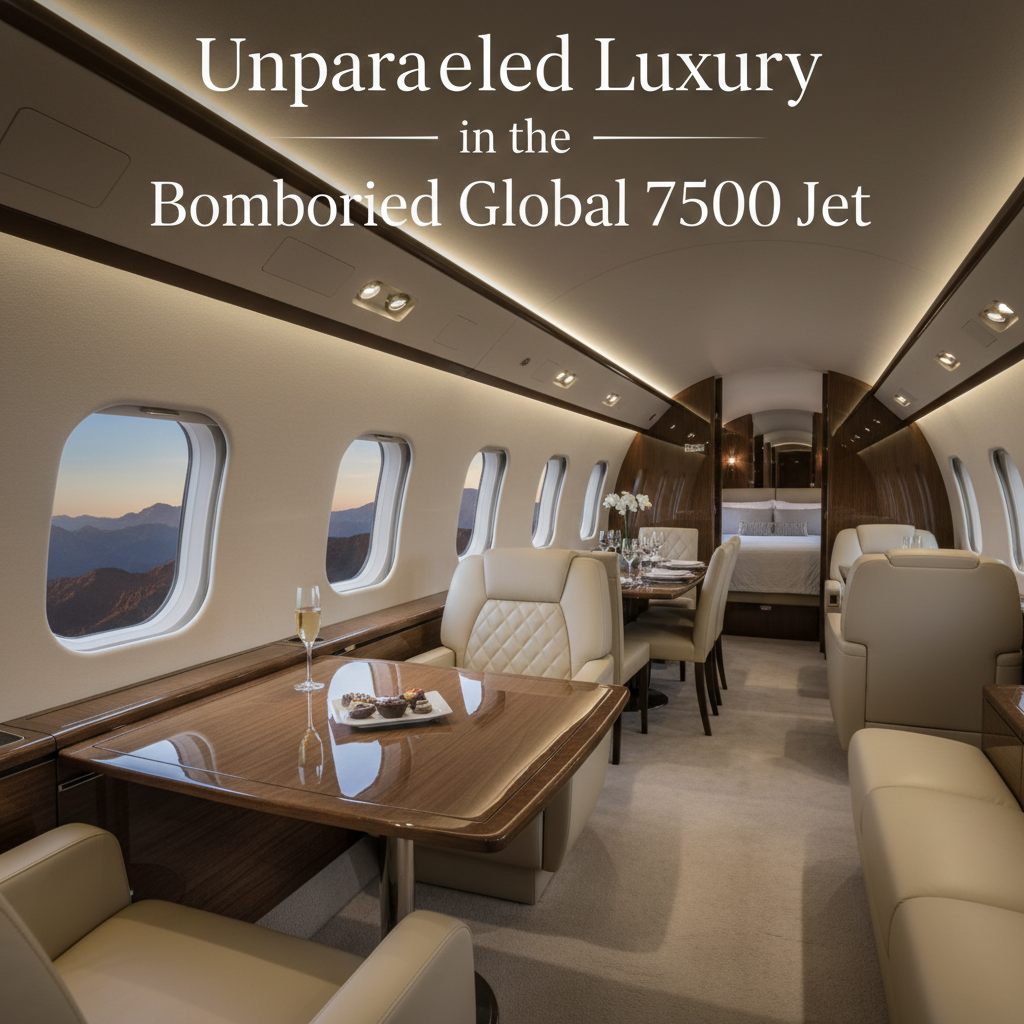
The Global 7500 exists because Bombardier decided to build the business jet that nobody asked for—at least not explicitly. Customers said they wanted range and comfort. Bombardier interpreted that as a mandate to construct something closer to a flying apartment than a traditional business jet, and somehow they pulled it off.
The experience stuck with me in ways that earlier business jet flights haven’t. The aircraft feels different from the moment you step aboard.
Size That Actually Matters
The cabin stretches 54 feet from the cockpit door to the rear lavatory. That’s not a number that means much on paper, but walking through the aircraft illustrates what Bombardier achieved. Four distinct living areas, each configured differently: a forward club seating zone, a central conference/dining space, a rear lounge that could pass for a living room, and a master suite that makes sleeping during transatlantic flights actually restful.
The windows are the largest in the industry, each about 30% bigger than competitors. Natural light floods the space in ways that trick your brain into forgetting you’re at 45,000 feet.
Wide aisles let people move through the cabin without that awkward sidle-past-each-other dance that even large business jets typically require. You can walk from front to rear without ducking, without turning sideways, without feeling constrained.
Range Changes Everything
The 7500 will fly 7,700 nautical miles without stopping. That’s Singapore to San Francisco. São Paulo to Moscow. Sydney to Los Angeles. Routes that previously required fuel stops or careful payload management now work nonstop with full passengers and baggage.
This range capability matters beyond the obvious convenience. Fuel stops consume time and attention—customs, security, ground handling, fresh flight crews at international stopovers. Eliminating stops on ultra-long routes turns 20-hour journeys into 16-hour journeys, with less hassle and lower operational complexity.
The aircraft achieves this range through efficient GE Passport engines and a wing design optimized for cruise performance. Bombardier’s engineers spent years in wind tunnels refining the aerodynamics, and the fuel burn numbers reflect that investment.
The Interior Possibilities
Standard configurations don’t really exist for aircraft at this level. Every 7500 gets customized to owner specifications, which means the aircraft I toured differs substantially from others in service. But the underlying flexibility remains consistent.
The galley can handle catering for multi-day trips. Meal service at 40,000 feet mirrors what you’d expect from upscale restaurants—not because the galley is magical, but because it’s sized to let trained cabin crew work properly instead of improvising in cramped spaces.
Entertainment systems integrate throughout the cabin. Bombardier developed a proprietary interface called nice Touch that controls lighting, window shades, temperature, and entertainment from tablet-style panels embedded at each seating position.
The master suite on properly configured aircraft includes a full-sized bed, a proper shower—not a cramped wet bathroom but an actual enclosed shower with decent water pressure—and enough floor space to change clothes like a human being instead of a contortionist.
What It Costs
List prices start around $75 million, but nobody pays list price for these aircraft. Actual transaction values depend on configuration, delivery position, and negotiation. Figure somewhere in the $70-80 million range for new deliveries.
Operating costs run high, as expected for an aircraft this size. Fuel burn at typical cruise configurations sits around 400 gallons per hour. Crew costs, hangar fees, maintenance reserves, insurance—the complete annual operating budget for regular use easily exceeds $3 million.
Charter rates, for those who want the experience without ownership, run approximately $15,000-20,000 per flight hour depending on operator and routing. A transatlantic charter might cost $200,000 or more.
Who Actually Buys These
The buyer profile has evolved as the market matures. Early adopters were the usual suspects—ultra-high-net-worth individuals, heads of state, multinational corporations with global travel requirements. The aircraft’s range suits executives who routinely cross oceans for meetings that require arriving rested.
Fractional ownership programs now include 7500 options, making the aircraft accessible to buyers who can’t justify whole ownership but have travel patterns that suit long-range business jet flights. NetJets, Flexjet, and others have added 7500s to their fleets.
Charter operators have discovered that certain routes justify 7500 deployment even against smaller, cheaper aircraft. Time-sensitive medical evacuations, entertainment industry travel during production schedules, corporate transactions requiring teams to cross continents quickly—these segments pay premiums for 7500 capability.
Competition and Context
Gulfstream’s G700 competes directly, offering similar range and cabin volume with different design philosophy. The G700 emphasizes speed slightly more—its high-speed cruise exceeds the Bombardier’s—while the 7500 arguably offers better interior flexibility.
Dassault’s Falcon 10X, still in development, promises comparable capability in a three-engine configuration that some operators prefer for over-water reliability.
Each manufacturer has loyal customers who defend their choices passionately. The objective differences between these aircraft matter less than the subjective preferences of owners who will live with them for years.
The Actual Experience
Flying in a 7500 feels strange at first because the reference points disappear. It doesn’t feel like a business jet. The proportions are wrong—too spacious, too quiet, too stable. The cabin altitude at typical cruise runs around 4,500 feet equivalent, low enough that passengers report less fatigue than in aircraft that pressurize to 6,000 or 7,000 feet.
Noise levels stay remarkably low throughout flight phases. The engines mount far enough aft that their sound barely penetrates the forward cabin. Conversations proceed in normal voices. Sleep comes easily in the proper beds.
This is what aviation luxury looks like when budget constraints essentially disappear. Whether that luxury justifies the cost depends entirely on the buyer. For those who genuinely need to cross oceans regularly while working, resting, or entertaining aboard—and who can afford the price—nothing currently flying does it better.



Stay in the loop
Get the latest aviation news updates delivered to your inbox.