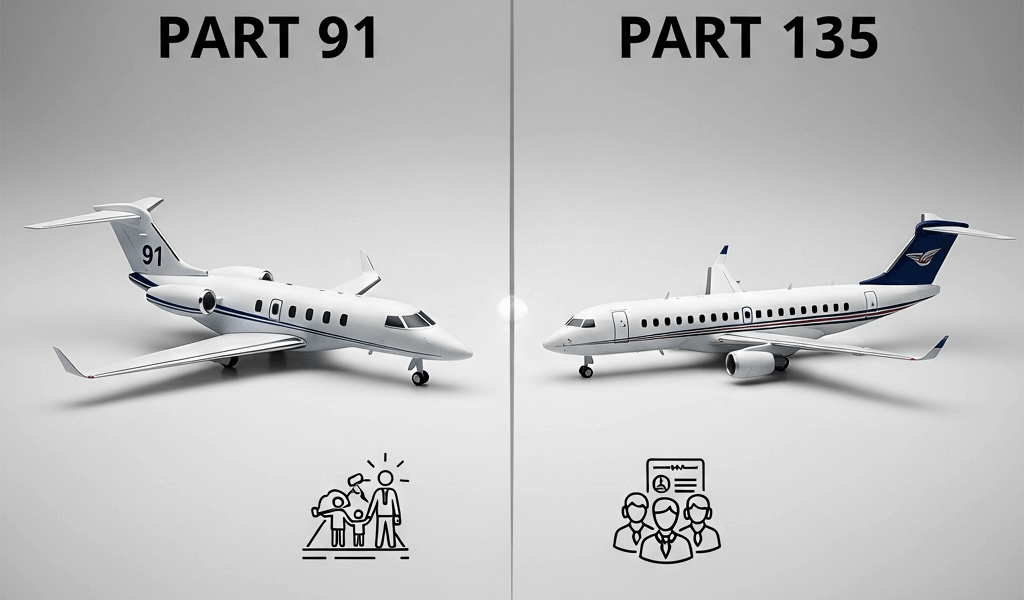
Part 91 vs Part 135 — What the Difference Means for Your Flight
The Part 91 vs Part 135 distinction is one of those things that sounds like regulatory alphabet soup until the moment it actually matters to you — and then it matters a lot. I spent several years working adjacent to charter operations, first as a ground crew coordinator and later helping a small FBO with scheduling and compliance documentation. That experience taught me that most people booking a private flight have no idea which set of rules governs their trip, and honestly, the aviation industry doesn’t go out of its way to explain it clearly. This article is my attempt to fix that.
Whether you’re a first-time charter customer trying to figure out what you’re actually paying for, or a student pilot who just cracked open the FAR/AIM for the first time and found yourself staring at a wall of federal regulations, this breakdown is for you. We’ll keep the legal language to a minimum and focus on what these rules mean in the real world — on the ramp, in the cockpit, and for your safety.
Part 91 vs Part 135 in Plain English
Title 14 of the Code of Federal Regulations — what most pilots just call the FARs — organizes aviation rules into numbered “parts.” Part 91 covers general operating and flight rules. Part 135 covers on-demand and commuter operations, which is the legal home of charter flying. They are not the same thing, and the gap between them is significant.
What Part 91 Actually Covers
Part 91 is the baseline. It applies to almost every aircraft operating in U.S. airspace, and it governs private flying — the weekend pilot taking his Cessna 172 up on a Saturday, the corporate flight department moving executives in a Gulfstream G550, the flight school running its Piper Archers in the pattern. Under Part 91, the owner or operator is flying for their own purposes. No compensation. No hire.
The rules under Part 91 are less stringent because the assumption is that the person accepting the risk is also the person choosing to take it. You own the airplane. You decide when it’s airworthy. You decide when conditions are acceptable. The FAA sets minimums, but you have considerably more latitude than a commercial operator does.
For a private pilot flying his own plane, Part 91 makes complete sense. He’s an informed participant accepting personal risk. The rules reflect that.
Where Part 135 Comes In
The moment someone pays for that flight, the calculus changes entirely. Part 135 exists to protect paying passengers — people who are not aviation professionals, who cannot assess aircraft airworthiness, and who are trusting a stranger’s operation with their lives. That’s a fundamentally different situation, and the FAA treats it that way.
Under Part 135, an operator must hold an Air Carrier Certificate issued by the FAA. Getting that certificate is not a simple process. It requires submitting an operations manual, demonstrating adequate maintenance programs, proving you have qualified personnel, and passing FAA inspection. The whole process can take six to twelve months for a new operator and costs tens of thousands of dollars to complete properly.
Stumbled across the term “air carrier certificate” and assuming it only applies to airlines? It doesn’t. A single-pilot, single-aircraft charter operation running a Pilatus PC-12 out of a regional airport still needs one if it’s flying passengers for hire on-demand.
The key operational differences under Part 135 include:
- Pilots must meet higher minimums — a Part 135 captain flying single-pilot IFR, for example, needs at least 1,200 hours total time, 500 hours cross-country, 100 hours actual instrument time, and 25 hours in the specific make and model
- Aircraft must undergo more rigorous maintenance inspections, including 100-hour inspections that are not required under Part 91
- Operators must have approved maintenance programs reviewed by the FAA
- Flight and duty time limitations apply, capping how long pilots can fly before mandatory rest — Part 91 has no equivalent restriction
- Aircraft must meet higher airworthiness standards, including specific equipment requirements based on the type of operation
- Operators must carry minimum insurance coverage levels as specified in their operating certificate
That’s a meaningful list. None of those requirements exist in Part 91 private operations. They exist in Part 135 because passengers have no other protection.
What This Means If You Are Chartering a Flight
Probably should have opened with this section, honestly. If you are the person writing the check, this is the part that directly affects you.
When you book a charter flight, you should be flying under Part 135. Full stop. If someone is selling you a seat on an aircraft and they do not hold a Part 135 certificate, you are in an illegal operation — and more importantly, you are in an operation that has bypassed every safety standard the FAA built specifically to protect you.
The Pilot Flying Your Charter
Under Part 135, the pilots operating your flight have met verified minimums. The FAA doesn’t just take the operator’s word for it. Pilot records, logbooks, training certificates, and medical certificates are all subject to inspection during FAA surveillance visits. The operator’s chief pilot has approved those pilots to fly specific equipment. Currency requirements are tracked and documented.
Under Part 91 private operations, a pilot needs a valid medical and a current flight review — that’s a biennial two-hour session with an instructor — to legally fly. That’s it. A pilot with 300 total hours and a private certificate can legally take his friends up in his Beechcraft Bonanza A36. That’s legal. It may also be unwise depending on the conditions, but the FAA cannot stop him from making that call.
I made the mistake once of accepting a “discounted” flight with a guy who described himself as running a “private air transport” service. He was operating his Piper Malibu under Part 91, accepting money under a gray-area timeshare arrangement that skirted the edge of legality. The airplane had a cylinder that had been running rough for weeks, which I only found out about afterward. He hadn’t addressed it because, operating under Part 91, no one was checking. That’s the difference. Real money, and I ended up in an airplane I would never have boarded had I done my homework.
The Aircraft Itself
Part 135 aircraft must comply with maintenance schedules that are reviewed and approved by the FAA. Most legitimate operators use computerized maintenance tracking systems — companies like Traxxall or CAMP (Continuous Airworthiness Monitoring Program) — to track every squawk, every component life limit, and every inspection interval. The FAA’s principal maintenance inspector for that certificate holder can walk in and pull those records at any time.
A Part 135 operator flying a Citation CJ3+ has a maintenance program that specifies exactly when every component gets inspected, replaced, or overhauled. The engines — Williams FJ44s in that case — have tracked life limits down to the cycle. Nothing gets deferred without documentation and, in many cases, FAA approval.
Compare that to a privately owned aircraft under Part 91, where the annual inspection is the primary safety gate. One thorough annual per year. The rest is up to the owner’s judgment and his mechanic’s recommendations. For a careful owner with a well-maintained aircraft, that can be entirely sufficient. For a charter passenger with no ability to evaluate the airplane before boarding, it’s not a system that protects you.
Insurance and Liability
Legitimate Part 135 operators carry substantial liability coverage — typically a minimum of $1 million per seat, often much higher. That coverage is a condition of their operating certificate. It’s not optional.
An individual flying under Part 91 may carry anywhere from $100,000 to whatever their personal policy covers. Some owners carry very little. If that flight ends badly, the path to any meaningful compensation for a passenger is far less clear.
When you’re comparing charter quotes and one operator comes in significantly cheaper than the others, the right question isn’t “why are they so affordable?” The right question is: “Are they actually Part 135 certificated?” Ask to see their operating certificate number and verify it at the FAA’s CAROL database. Takes about ninety seconds. Worth doing every time.
Part 121 — How Airlines Are Different From Both
To complete the picture, you need one more number. Part 121 governs scheduled air carrier operations — your Delta, United, Southwest, and every other scheduled commercial airline. It is the most stringent tier of the three.
The Three-Tier System
Think of it as concentric circles of regulatory oversight:
- Part 91 — private operations, most training, corporate aviation. The baseline. Flexible, personal accountability, minimal third-party oversight of day-to-day decisions.
- Part 135 — charter, on-demand, and commuter operations (fewer than 30 seats). Significantly elevated requirements. FAA-certificated operator with approved manuals and programs.
- Part 121 — scheduled airline service. The highest standard. Crew resource management requirements, first officer hour requirements of 1,500 total time (1,000 in some military transition cases), mandatory rest rules under the 2013 fatigue rule revisions, simulator training requirements measured in dozens of hours per year per crew member.
Airlines fly under Part 121 all the time, on every scheduled departure. The Boeing 737-800 departing from gate C22 at 7:05 AM on United has two pilots who each went through type rating training in a full-motion Level D simulator — a box that costs roughly $20 million and costs operators around $2,000 to $3,000 per hour to operate. Their training records go back years. Their fatigue status was calculated before dispatch. Their aircraft has maintenance records going back to the day it rolled out of Renton, Washington.
Part 135 is rigorous. Part 121 is another tier beyond that.
Why Charter Isn’t Airline Service — and That’s Fine
This isn’t an argument that charter is unsafe. Properly operated Part 135 charter is genuinely safe. The accident rate statistics bear that out. The point is that these regulatory tiers exist for reasons that are grounded in operational reality, and understanding them helps you make informed decisions as a consumer and as a pilot.
A Bombardier Challenger 350 flown by a legitimate Part 135 operator with two properly qualified pilots, current training records, and a maintained airworthiness program is a safe, well-regulated product. The rules around it were written to make it that way.
What the rules cannot do is protect you from an illegal operation masquerading as something it isn’t. That protection has to come from you doing a few minutes of due diligence before you board.
A Final Note for Student Pilots
If you’re a student or low-time pilot reading this while trying to understand where you fit into the regulatory landscape — you’re operating under Part 91. When you build enough hours and ratings to fly charter, Part 135 will become your world, and its requirements will shape your training goals. The 1,200-hour IFR captain minimum under Part 135 single-pilot operations isn’t an arbitrary hurdle. It represents a reasoned judgment about the experience level needed to safely manage a complex aircraft, an instrument environment, and passenger responsibility simultaneously.
Understanding why these rules exist — not just what they say — makes you a better pilot and a more informed participant in the aviation system. Start with Part 91. Respect what Part 135 represents. And when you eventually fly for hire, carry the obligation that comes with it seriously.


Stay in the loop
Get the latest aviation news updates delivered to your inbox.