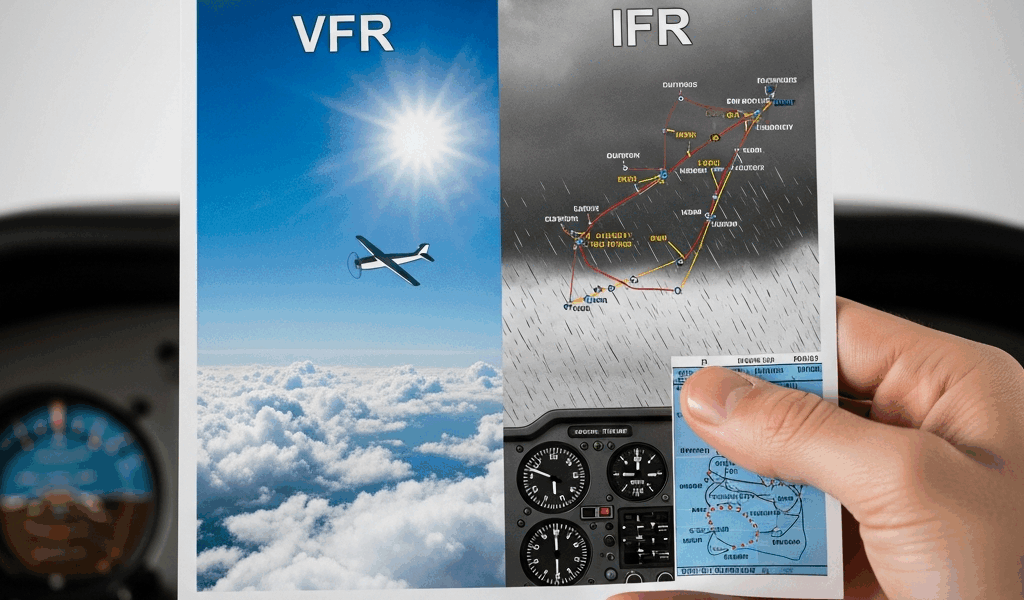
IFR vs VFR Flying — What Every Pilot Needs to Know
This article includes affiliate links. We may earn a commission at no extra cost to you.
IFR vs VFR has gotten complicated with all the conflicting explanations flying around — forums, YouTube videos, well-meaning instructors who each describe it differently. As someone who stumbled through 60 hours of VFR training before finally cracking open the instrument world, I learned everything there is to know about this distinction the hard way. The rewiring that happened when I started my instrument rating was genuinely jarring. This isn’t just a regulatory split — it reshapes how you think about weather, airspace, and honestly, what flying even is.
VFR vs IFR — The Core Difference
Let’s get the definitions straight, because fuzzy understanding here creates real problems down the line.
VFR stands for Visual Flight Rules. But what is VFR, exactly? In essence, it’s a framework where you — the pilot — are personally responsible for seeing and avoiding other aircraft, terrain, and obstacles. But it’s much more than that. The FAA sets specific weather minimums: visibility distances, cloud clearance requirements. Meet those minimums, and you can navigate using visual reference to the ground and horizon. Your eyes are the primary instrument. You are the see-and-avoid system.
IFR stands for Instrument Flight Rules. And what is IFR? In essence, it’s an entirely different operating framework where ATC — air traffic control — handles separation services, tracking your position relative to other IFR traffic. But it’s much more than that. You navigate via cockpit instruments: attitude indicator, altimeter, heading indicator, and whatever navigation gear the airplane has — maybe a Garmin GTN 750, maybe an old VOR receiver held together with optimism. Seeing outside isn’t required to know where you are.
Here’s the part that trips people up. IFR and VFR aren’t just pilot ratings — they also describe weather conditions. IMC means Instrument Meteorological Conditions — cloudy, low visibility, not safe for visual flight. VMC means Visual Meteorological Conditions. You need an instrument rating to operate in IMC. Flying VFR into IMC is one of the most reliably fatal things a pilot can do, and it still kills people every year. Every year.
The “See and Avoid” Limitation
See-and-avoid works — until it absolutely doesn’t. In Class G or Class E airspace on a clear afternoon, it’s perfectly reasonable. You scan, you spot traffic, you adjust. Simple enough.
But the system has hard limits. You can’t see through clouds. You can’t hold visual reference when visibility drops to a quarter mile in fog. At night, your ability to spot unlit terrain essentially collapses. That’s what makes IFR endearing to us instrument pilots — it doesn’t pretend the visual world is always available.
IFR flips the responsibility structure entirely. ATC watches your transponder return on radar, issues traffic advisories, provides separation. You file a flight plan. The system knows where you’re going before you get there. IFR isn’t magically safe — plenty of IFR accidents happen, and the NTSB reports are humbling reading — but it builds in redundancy that VFR simply doesn’t have.
Where Each Set of Rules Applies
VFR is available in most airspace as long as weather meets class-specific minimums. Class B around major airports — LAX, O’Hare — requires a clearance even in VMC. Class G airspace out in genuinely empty countryside has pretty relaxed standards: 1 statute mile visibility during the day, for instance. Rules shift by airspace class, altitude, and time of day. The FAA knowledge test drills this extensively, and honestly, it should.
IFR operations need a clearance and a filed flight plan. You can actually fly IFR in VMC — sometimes called “VFR on top” in certain contexts, or just running an IFR flight plan in clear conditions. Instrument-rated pilots do this regularly, particularly in busy airspace where the traffic separation benefit alone is worth it.
What You Can Do With Each Rating
Probably should have opened with this section, honestly, because this is what actually matters when you’re weighing whether to spend the money and time on additional training.
With a private certificate and no instrument rating, you’re VFR-only. Here’s what that means on a practical level:
- You need 3 statute miles visibility and specific cloud clearances — 500 feet below, 1,000 feet above, 2,000 feet horizontal from clouds in Class E airspace
- Clouds are off-limits under any circumstances
- Night VFR is legal, common, and carries real risk — terrain awareness degrades significantly after dark
- Special VFR exists as a workaround, but it has its own restrictions and isn’t available at Class B airports
- A solid overcast at 800 feet means you’re not going anywhere — full stop
I learned that last point the uncomfortable way on a flight from Oshkosh back toward Chicago in a Cessna 172. Weather briefing looked workable. By the time I was 40 miles out, a layer had moved in — 600-foot ceiling staring back at me. Technically legal minimums. I diverted to Waukesha anyway and drove the rest of the way home. Without an instrument rating, that was the only defensible call. Frustrating. Expensive. Absolutely necessary. Don’t make my mistake of cutting the preflight weather analysis short because the morning forecast looked promising.
What the Instrument Rating Actually Unlocks
Once you hold an instrument rating — and you’re current, meaning you’ve logged the required approaches and holds within the past six months — the operational world expands considerably.
- Flying in clouds becomes legal, provided you’re on an IFR clearance
- Instrument approaches to minimums as low as 200 feet AGL are accessible — with the right aircraft, avionics, and airport equipment
- Airports and airspace that are practically unreachable in low-visibility VFR conditions become routine destinations
- You can fly through the backsides of weather systems rather than just routing around them
- ATC separation reduces midair collision risk meaningfully in congested airspace
The utility gap between VFR-only and instrument-rated isn’t marginal. A VFR pilot in a typical American winter might sit on the ground for stretches of weeks at a time. An instrument-rated pilot in a well-equipped airplane keeps flying — not always, not in everything. Thunderstorms, icing, severe turbulence — those are hard stops regardless of what’s in your logbook. But routine low overcast, mist, light rain? That’s just a workday for an instrument pilot.
Airspace Access
Here’s something that doesn’t get discussed enough. Certain airports are practically inaccessible to VFR pilots during specific seasons — not occasionally, but routinely. Flying into San Francisco in the morning? The marine layer sits at 300-400 feet from October through May on a pretty regular basis. No instrument rating means diverting to Oakland or San Jose and hoping the situation improves. With it, you file IFR, get your clearance, and fly the ILS into SFO like a normal person.
There’s also this: the instrument rating makes you a more capable VFR pilot. Full stop. Your scan improves. Your weather knowledge deepens. You understand what ATC is doing and why — which, before instrument training, is often a mystery. Reading a METAR and TAF becomes genuine comprehension rather than just checking boxes. The checkride is demanding, the training is genuinely hard — but the pilot who comes out the other side is categorically different from the one who went in.
Night Flying Considerations
Night VFR deserves its own mention — it’s a strange middle ground. Legal, common, and substantially riskier than day VFR for one simple reason: terrain awareness essentially disappears. A pilot flying at night over unlighted terrain is operating in conditions that look a lot like partial IMC whether they acknowledge it or not. Many experienced pilots treat night flying over mountains or water almost like instrument flying — disciplined altitude management, constant instrument cross-check, no reliance on a visual horizon that may or may not exist out there in the darkness.
An instrument rating doesn’t eliminate night flying risk. But it gives you the skill set to handle exactly the conditions that make night flying dangerous in the first place.
Should You Get Your Instrument Rating?
Frustrated by a canceled trip to visit family in Colorado — solid IFR day, no legal VFR option, sitting in a FBO in Denver watching the ceiling — I started instrument training the following January. Best $8,500 I’ve ever spent on aviation. Here’s how I’d think through the decision.
The Honest Cost Breakdown
The instrument rating requires a minimum of 50 hours of actual or simulated instrument time — 40 of which must be in actual conditions or a certified flight simulator. Realistically, most pilots need 60-80 total hours of instrument instruction before they’re genuinely checkride-ready.
At current rates — roughly $180-$220 per hour for a Cessna 172 with a CFII — you’re looking at somewhere between $9,000 and $15,000 depending on pace, instructor, and how quickly proficiency develops. Add written test prep — King Schools runs a solid course for around $150 — plus the checkride fee ($700-$900 depending on examiner and location), and $12,000 is a reasonable planning number for most people.
A technically advanced aircraft with a Garmin G1000 panel might be the best option for some, as instrument training requires genuine avionics fluency. That is because modern IFR operations are deeply integrated with glass cockpit systems — time spent learning them during training pays off immediately. Steam-gauge airplanes like a Piper Warrior build fundamental scan skills faster, though. Both approaches work. While you won’t need the fanciest equipment available, you will need a handful of reliable tools: current charts, a solid flight bag setup, and ideally an airplane you’ll fly for the rating and beyond.
Who Should Definitely Get It
First, you should pursue the instrument rating — at least if you’re flying for actual transportation. Using an aircraft to get places on a schedule with no instrument rating is an exercise in frustration. A VFR-only pilot trying to run a Cessna 182 for business travel in the Midwest will be grounded a significant portion of the year. The rating pays for itself in canceled trips avoided and last-minute airline tickets not purchased.
Flying in mountainous terrain? Pacific coastal regions? Anywhere marine weather is a regular feature? Same answer. Get the rating.
And if any professional aviation path is on the horizon — multi-engine commercial operations, anything with a paycheck attached — the instrument rating is simply the next step. Not optional.
Who Can Wait
Weekend recreational flying in a clear-weather climate — Phoenix, Las Vegas, parts of Texas — with flexible schedules and zero time pressure? Building hours as a VFR pilot first makes sense. Get to 150-200 hours. Get comfortable with cross-country navigation and aircraft systems. Then start instrument training with a foundation that actually means something.
The instrument rating is harder when you’re brand new. Not impossible — some pilots go straight from private to instrument and do fine. Others clearly benefit from more stick time first. Know yourself. Apparently some instructors push students straight through regardless, which works for some people and produces genuinely dangerous gaps in others.
The Real Reason to Get It
Competence. That’s it, honestly. The instrument rating builds a more complete pilot — one who understands weather at a level most VFR pilots never reach, who brings discipline and precision to every flight, who operates systematically rather than reactively. Every pilot I genuinely respect holds this rating. Not because it was required. Because they understood that becoming actually good at this thing means learning to fly when you can’t see.
The gap between VFR and IFR flying isn’t just regulatory. It’s a gap in capability, safety, and real understanding of the environment you’re operating in. Close it when you’re ready. Just make sure you close it.



Stay in the loop
Get the latest aviation news updates delivered to your inbox.