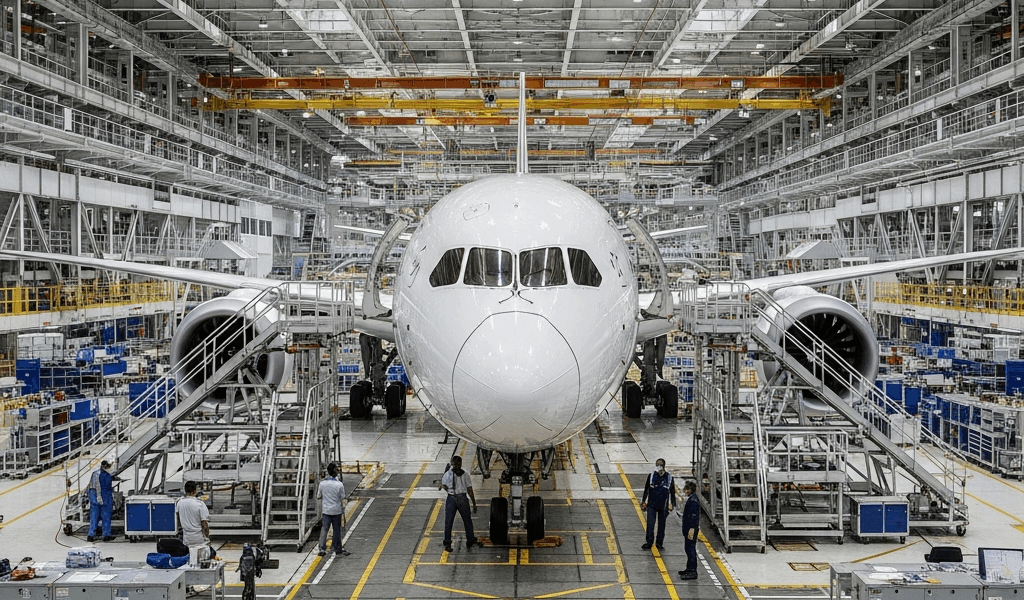
Lufthansa Group’s Supervisory Board has approved a major order for 20 widebody aircraft—10 Boeing 787-9 Dreamliners and 10 Airbus A350-900s—with deliveries expected between 2032 and 2034. The deal, valued at approximately $7.7 billion at list prices, marks a significant step forward in the carrier’s fleet modernization push and signals a strong commitment to twin-engine long-haul aircraft as the airline phases out its aging four-engine widebodies.
The Supervisory Board gave its formal approval on May 11, 2026, after an earlier decision by the Executive Board. Back in March, Lufthansa CEO Carsten Spohr had already hinted at what was coming. Speaking at the Airlines for Europe summit in Brussels, he said a decision was “a few weeks away” and that aircraft would begin arriving in 2033.
“By ordering 20 additional long-haul aircraft, we are making a sustainable investment in the future of the Lufthansa Group,” Spohr said in a statement. “It is a clear commitment to a modern fleet, to premium quality, and to further reducing CO₂ emissions. The state-of-the-art Airbus A350 and Boeing 787 are more fuel-efficient, quieter, and have lower emissions than their respective predecessors.”
Fleet Replacement Strategy
These aircraft will replace older, less efficient widebodies now in service—including Airbus A330s, A340s, and Boeing 747-400s. The order brings Lufthansa Group’s total order book to 232 aircraft, of which 107 are next-generation long-haul jets. Which group carriers get which planes—Lufthansa, SWISS, Austrian Airlines, Brussels Airlines, and ITA Airways—will be sorted out later, based on network requirements.
The split between Airbus and Boeing tells its own story about supply constraints. Airbus’s A350 production line is booked solid into the early 2030s, so Lufthansa had to pursue additional 787s to lock in delivery slots. The timing also buys the airline some breathing room as it waits for Boeing 777-9 deliveries, which are now expected to start in 2027 after repeated certification delays.
As of May 2026, Lufthansa operates 31 A350-900s and 16 787-9s. The airline still has 21 A350-900s and 15 A350-1000s waiting to be delivered from previous orders, along with 23 787-9s and 20 777-9s on the books. The new order reflects deep confidence in both aircraft families—and underscores Lufthansa’s ambition to cut long-haul aircraft types from 13 down to just 6 by 2030.
Financial and Operational Context
The announcement arrives on the heels of remarkable financial results. Lufthansa Group posted its strongest year in 100 years during 2025, pulling in revenue of €39.6 billion with adjusted EBIT of approximately €2 billion. The carrier is expecting around 45 aircraft deliveries in 2026—a mix of short-haul A220 and A320neo family jets, plus long-haul A350 and 787-9 additions.
Lufthansa points to fuel efficiency gains of up to 30 percent on new aircraft compared to what they’re replacing, alongside lower maintenance costs, less operational complexity, and reduced emissions. Fleet standardization will also improve crew licensing, training, and spare parts management—a crucial advantage given rising labor costs in Germany and the strike actions the airline has faced repeatedly over the past two years.
In related news, Lufthansa announced it will exercise an option to buy a majority stake in ITA Airways, boosting its holding from 41 percent to 90 percent for €325 million, pending European Commission and U.S. Department of Justice approval. The deal is expected to close in the first quarter of 2027.
The 787 and A350 orders fit squarely into Lufthansa’s wider strategy—retire the four-engine widebodies and rebuild the long-haul network around modern twins. The Boeing 747-400 is scheduled to exit service in stages by 2027. As of May 2026, the Airbus A340-600 is planned to be phased out by the end of the 2026 summer season.
Sources
- Simple Flying
- Aerospace Global News
- Lufthansa Group Official Press Release (newsroom.lufthansagroup.com)

Stay in the loop
Get the latest aviation news updates delivered to your inbox.