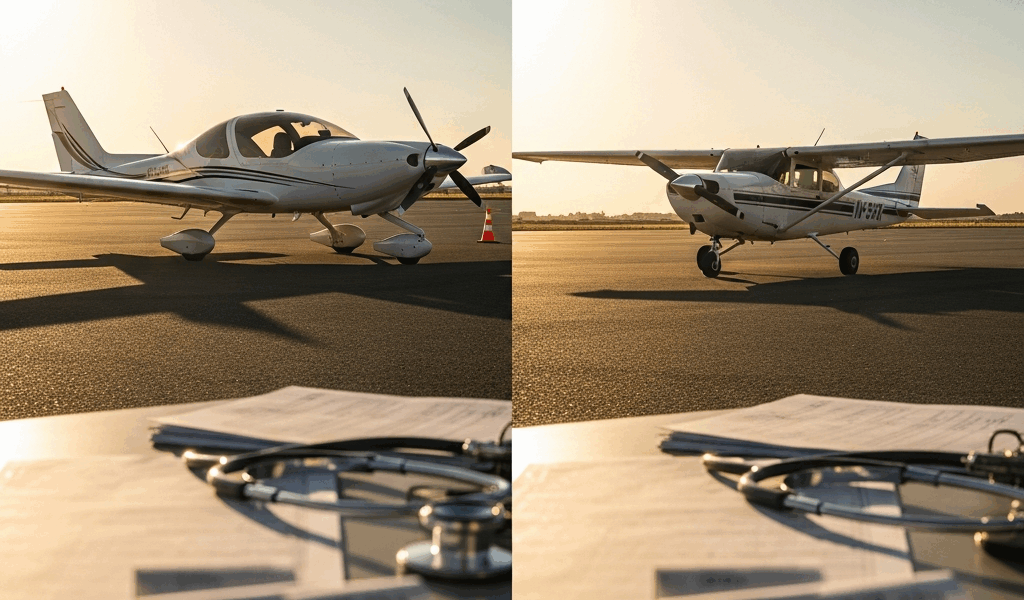
Sport Pilot vs Private Pilot — Which Path Actually Saves Money
The sport pilot vs private pilot cost question has gotten complicated with all the half-baked comparisons flying around. I spent months researching this before writing a single check to a flight school — and I still got surprised by the final number. Most articles throw the FAA minimums at you and call it done. Forty hours versus twenty hours, there you go, see ya. That framing misses everything that actually matters when you’re budgeting for a certificate. What follows is a real-dollar breakdown of both paths, including the fees that never show up on flight school websites.
What Each Certificate Actually Lets You Do
But what is a sport pilot certificate, exactly? In essence, it’s a streamlined license letting you fly light sport aircraft — under 1,320 pounds, two seats max, fixed gear — during daylight hours in visual conditions with one passenger. But it’s much more than that, or rather, much less, depending on what you actually want to do with it.
That covers a lot of Saturday morning flying over farmland. Genuinely does.
Here’s where it gets limiting fast. Sport pilots cannot fly in Class B, C, or D airspace without a specific logbook endorsement from a CFI. No flying above 10,000 feet MSL. No international flights. No compensation or hire — ever. And that aircraft ceiling matters more than most people realize. If your local flying club runs Cessna 172s and Piper Cherokees, your sport certificate is useless there. Full stop.
Private pilot removes almost all of those walls. Night flight, controlled airspace, heavier aircraft, cross-countries into Class B airports — it’s all on the table. The private certificate is the one the wider aviation ecosystem is built around. That’s what makes it so endearing to us aviation folks who eventually want to go somewhere useful.
The Real Cost Breakdown Side by Side
Probably should have opened with this section, honestly. Numbers first, philosophy later.
Sport Pilot — Realistic Total Cost
- Flight training hours: FAA minimum is 20 hours, but national averages run 35–45 hours. At $180–$220/hour for a typical LSA rental — think a Cessna 162 Skycatcher or a Flight Design CTLS — that’s $6,300–$9,900 in aircraft time alone.
- Instructor fees: Expect $55–$75/hour on top of the rental, covering roughly 15–20 hours of dual instruction. Add $825–$1,500 to your running total.
- Ground school: Online options like Sporty’s Sport Pilot course run $199. Structured in-person ground adds $400–$800.
- Checkride: DPE fees vary by region — sometimes wildly. Budget $600–$900.
- Medical: Zero cost if you self-certify using a valid driver’s license. That is a real advantage and I’ll come back to it.
- Written test fee: $175 at most testing centers.
Realistic sport pilot total: $8,100–$13,500
Private Pilot — Realistic Total Cost
- Flight training hours: FAA minimum is 40 hours; national average lands around 60–70 hours. A Cessna 172S rents for $145–$185/hour wet at most Part 141 and Part 61 schools. At 65 hours average, you’re looking at $9,425–$12,025.
- Instructor fees: Same $55–$75/hour range, covering 20–30 dual hours. Add $1,100–$2,250.
- Ground school: $199–$900 depending on format.
- Checkride: $700–$1,000.
- Third-class medical (FAA): AME exam runs $75–$150 out of pocket. Or BasicMed — a one-time physician visit, typically $100–$200, plus a $25 online course. Most private pilots go BasicMed now unless they’re chasing a commercial certificate.
- Written test fee: $175.
Realistic private pilot total: $11,600–$16,550
The Comparison in Plain Numbers
| Cost Item | Sport Pilot | Private Pilot |
|---|---|---|
| Aircraft rental (avg hours) | $6,300–$9,900 | $9,425–$12,025 |
| CFI instruction | $825–$1,500 | $1,100–$2,250 |
| Ground school | $199–$800 | $199–$900 |
| Medical | $0 | $100–$200 |
| Checkride + written | $775–$1,075 | $875–$1,175 |
| Realistic Total | $8,100–$13,500 | $11,600–$16,550 |
The gap is real but not enormous — roughly $3,000–$5,000 on average. And LSA aircraft aren’t always cheaper to rent than a 172. Some schools actually charge more per hour for a Flight Design CTLS than for an older Cessna 172N. I learned this the hard way. Don’t make my mistake: call three local flight schools and ask for their actual wet rental rates before assuming LSA is automatically the budget option.
Where Sport Pilots Hit a Wall
Nobody warns you going in about the sport certificate’s limits. Nobody. You find out gradually — sometimes 30 hours into training.
Flying clubs are the first wall. Most established clubs operate Cessna 172s, Piper Archers, or Beechcraft Sundowners. A sport certificate doesn’t qualify you to fly any of them. You’d be paying monthly club dues for aircraft you literally cannot touch.
Employment is another wall — a hard one. Any aviation-adjacent job, even towing banners or doing traffic watch, requires at least a private certificate. Flying for compensation or hire is simply off the table with sport privileges. I’m apparently someone who considered banner towing as a side gig, and the sport certificate would have been completely useless for that while the private certificate opens it right up. If there’s any chance you’ll want to earn money flying later, start with private.
The 10,000-foot MSL ceiling eliminates mountain flying across much of the western United States. The daytime-only restriction catches people during winter — daylight windows get tight fast in December. And no instrument rating is available from the sport certificate. Want to fly IFR someday? You’ll be earning your private certificate anyway, adding cost to your total investment either way.
None of this is meant to dismiss sport pilot. It’s a legitimate certificate for a specific kind of flying. Walking in with clear eyes just beats being blindsided 50 hours in.
Who Should Actually Choose Sport Pilot
Frustrated by medical certification requirements, many experienced aviators and newcomers alike have found the sport route genuinely life-changing. The self-certification rule — a valid U.S. driver’s license substituting for a medical exam — is the single most compelling reason to choose this path. Full stop.
Sport pilot makes strong sense if you:
- Have a medical condition that disqualifies you from a third-class medical but doesn’t affect your driving privileges
- Want to fly a specific LSA — a Bristell, a Sling 2, or an Icon A5 — and have zero interest in anything heavier
- Plan exclusively recreational flying within 50 miles of a home airport, VFR, on weekends
- Have no aviation career ambitions, now or later — and mean it
- Live near a school with affordable LSA rental rates and a full schedule of available aircraft
If you’re 35, healthy, want to take family trips, or haven’t firmly ruled out instrument training someday — sport pilot will cost you money twice. Once to get the certificate, again when you upgrade. That math gets ugly fast.
How to Make the Call Before You Start Training
Four questions. Answer them honestly and the decision essentially makes itself. So, without further ado, let’s dive in.
- Can you pass a third-class medical? If yes, private pilot is almost always the better investment. If medical certification is genuinely uncertain, sport pilot with driver’s license self-certification changes the math entirely.
- What aircraft does your local school or club actually operate? No LSAs available? The sport certificate is useless to you on day one.
- Do you have any career interest in aviation — even a distant one? Any “maybe” here should default you to private pilot. No exceptions.
- Is your flying purely local and recreational, permanently? Firm yes means sport pilot delivers real value for less money. Anything softer than firm — go private.
Here’s the direct recommendation: most people should get the private certificate. The additional $3,000–$5,000 buys enormous flexibility, keeps every door open, and matches how the actual flying infrastructure — clubs, rentals, airspace, career paths — is built. Sport pilot is the right answer for a specific person with specific constraints. Not a universal budget shortcut.
Next step: talk to a CFI at your nearest Part 61 school and ask them to walk you through both paths using their specific aircraft rates. Better yet, if sport pilot is genuinely on the table, contact an FAA-approved LSA dealer and book a demo flight. Thirty minutes in a Flight Design CTLS will tell you more than any article — including this one.


Stay in the loop
Get the latest aviation news updates delivered to your inbox.