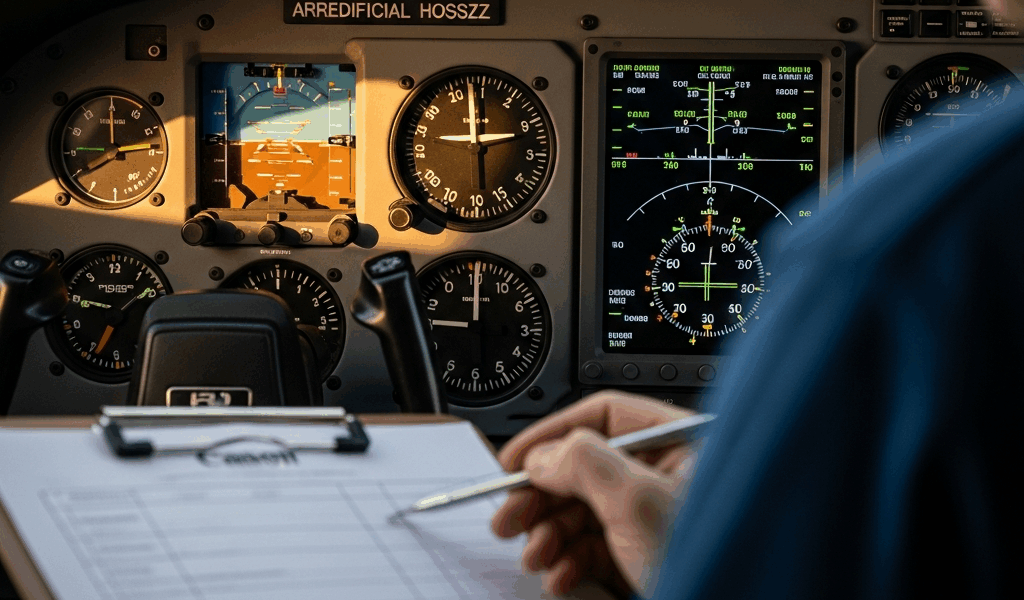
Why Checkride Failures Happen More Than People Admit
Private pilot checkride failures have gotten complicated with all the misinformation and forum mythology flying around. I’ve spent years watching students walk into practical tests underprepared in eerily similar ways — and walk out holding a Notice of Disapproval that nobody saw coming. The FAA doesn’t publish official failure rates, but DPEs and flight instructors consistently report somewhere between 10 and 15 percent of applicants don’t pass on the first attempt. That number surprises people. It shouldn’t.
Here’s the honest part: most failures aren’t random. DPEs see the same patterns — over and over and over. A student struggles with slow flight configuration changes. Another can’t defend a weather decision under pressure. A third loses situational awareness during a diversion and never finds it again. The Airman Certification Standards document is precise about what gets tested. It’s vague about what students actually need to know to pass. That gap is exactly where failures live.
Oral Exam Gaps That Surprise Most Applicants
The oral exam is where the most preventable failures happen. Students memorize facts. DPEs ask for understanding. There’s a meaningful difference — and most applicants never figure that out until it’s too late.
Airspace Confusion and the Missing Context
Class B airspace. Class D. Mode C altitude encoding rules. Students can recite these definitions cold from the AIM. What they can’t do is apply them under pressure when a DPE asks: “You’re at 8,500 feet MSL, 25 miles northeast of a Class B airport. Do you need a Mode C transponder?”
The answer depends on layers of context — distance, altitude, whether you’re inside or outside a shelf, whether the floor of the Class B even extends that far out. Most applicants studied the altitude numbers. Not the spatial reasoning. A DPE will ask the same question three different ways and watch you struggle. That’s a failure signal.
Study airspace by drawing it. Pull up SkyVector or ForeFlight, plot your position, and physically trace the boundaries. Don’t just read the definitions. That approach doesn’t work — at least not if you want to actually pass.
Weather Minimums and Real-World Decision Failures
Probably should have opened with this section, honestly. Weather decisions are the single largest category of oral failures DPEs report — and the reasoning is always the same. Ceiling minimums for VFR flight, visibility requirements for Class E airspace below 10,000 feet, special VFR minimums — these aren’t isolated facts. They’re contextual rules. Students almost universally study them as facts.
A DPE will hand you weather for three different airports and ask which one is legal to fly to under VFR. Then they’ll change one number and ask again. Students freeze. They memorized “3 SM visibility” but never internalized why that number exists or how it shifts with airspace class and altitude. That’s what makes weather minimums so treacherous for applicants — the rules feel simple until they aren’t.
Aircraft Documentation and the AROW Trap
Airworthiness certificate. Registration. Operating limitations. Weight and balance. Every student has heard AROW. Most have never actually looked at the original documents inside the specific aircraft they’ll be tested in. That’s the failure pattern — and it’s embarrassingly common.
A DPE asks: “Show me the maximum weight for this aircraft and tell me where you found it.” Student points to the POH. DPE says, “That’s the manufacturer spec. Now show me the actual authorized maximum weight.” Student stares blankly, because they never checked the airworthiness certificate — which is where the FAA sets the legal limit, sometimes lower than what’s printed in the POH.
Spend 20 minutes with the actual paperwork in your checkride aircraft before test day. Not Sporty’s study materials. Not the Gleim handbook. Real documents, in the real airplane. Don’t make my mistake.
Maneuvers That Fail More Often Than Students Expect
Smooth air. Calm day. Plenty of fuel. Flight schools schedule checkrides in the best possible conditions. Then reality intrudes — a crosswind gust, a thermal bump, one bad moment. The student’s hands tighten on the yoke and the maneuver unravels.
Slow Flight Configuration Changes and Altitude Loss
Slow flight kills more checkrides than any single maneuver. The ACS requires maintaining altitude within 100 feet while transitioning from clean configuration to approach configuration to landing configuration. Sounds straightforward. It isn’t.
Most students practice slow flight at one power setting in one configuration. Then the DPE says, “Now add flaps.” Drag spikes suddenly. The nose wants to drop. The student adds power too late or too little. Altitude decays 150 feet before they recover. That’s a failure — clean and simple.
The real problem is that students have memorized a procedure but haven’t developed the feel. Practice slow flight transitions at 50-foot altitude increments in varying configurations, ideally with some light turbulence mixed in. Understand why the nose does what it does. The procedure won’t save you. The understanding will.
Steep Turns and the Altitude Bleed Pattern
Steep turns demand 100 feet of altitude tolerance. Start at 5,000 feet, hold heading within 10 degrees, don’t drop below 4,900. Most DPEs ask for two 360-degree turns in opposite directions.
The failure pattern is almost mechanical at this point: first turn is fine. Second turn, the student is tired. Workload is high. They stop cross-checking the altimeter as carefully. They drop 150 feet. DPE notes it. No re-test offered.
I’m apparently a visual scanner by nature, and keeping a strict three-second altimeter check works for me while winging it on feel never does. After dozens of practice steep turns, the real skill I finally understood wasn’t the turn itself — it was altitude management throughout. The horizon shifts as you bank. The instruments tell a different story. Most students fixate on the heading indicator and forget the altimeter entirely.
Soft-Field Takeoff Technique and the Rotation Mistake
Soft-field takeoffs fail because students rotate too early, too late, or with sloppy airspeed control. The ACS wants proper technique on unprepared or grass surfaces — raise the nose wheel early to unload the nose gear, but not so early that you’re approaching stall speed at 40 knots. The margin is narrow.
Most failures come when students panic. They feel the bumps of rough terrain and instinctively haul back harder on the yoke. The aircraft rotates prematurely, groundspeed is still embarrassingly low, and stall speed is uncomfortably close. A DPE will call it immediately. There’s no talking your way out of it.
Stall Recovery and the Power-Before-Level Trap
Stall recovery is mechanically simple. Lower the nose. Reduce bank angle. Add power once the wing is flying again. Most students reverse steps two and three — they add power while still banked, which makes everything worse. Some add full power before the nose is even down, spiking the torque effect and deepening the stall.
This is the one failure that can be completely eliminated with proper training. But students rush it. DPEs catch it every time. No exceptions.
Cross-Country and Navigation Errors That End Checkrides Early
The diversion task arrives midway through the flight. DPE gives you a new destination 20 miles out. Navigate there, compute an ETA, brief the maneuver. This is where panic lives — and where a lot of checkrides quietly die.
The Positional Awareness Collapse
Students lose themselves geographically far more often than they make math errors. You’re supposed to maintain situational awareness using a sectional chart and ground references. Many students spend the entire flight staring at the instrument panel. When the diversion task arrives, they can’t locate themselves within a two-mile radius. That’s not a navigation failure. That’s a scan pattern failure.
A DPE watches where your eyes go. Are you looking outside? Are you correlating terrain below with the sectional in your lap? Are you pointing to landmarks as you pass them? Or are you flying on instruments and quietly hoping the Garmin G1000 is right?
Practice diversions on actual cross-country flights with GPS completely off. Fold your chart. Point to landmarks. Verbally confirm your position every 30 seconds. It feels painfully slow. That’s the point.
Diversion Math Failures and Poor Communication
The math isn’t hard. Distance, time, groundspeed, fuel burn — basic stuff. But students make mental arithmetic errors under stress, and honestly, the math isn’t even what DPEs are grading. They’re evaluating judgment.
A DPE will give you a diversion to an airport with deteriorating weather, unfavorable winds, or a fuel situation that’s tight. The real test is whether you communicate your thinking out loud and make a sound decision. Say, “The destination is showing a 300-foot ceiling — that’s below VFR minimums. I’d like to divert to the alternate at KLVN instead.” That’s a pass. Stare silently at the sectional while sweat drips on it. That’s a failure.
VFR Weather Decision Failures in Real Time
During the flight portion, weather will change. The ACS expects you to make sound decisions about whether to continue, divert, or land. Many students try to push through because they’re on a checkride and don’t want to look uncertain. That instinct is exactly wrong — and DPEs know it immediately.
A DPE watches how you respond to actual conditions. Uncertainty is fine. Communicating uncertainty is the skill they’re testing. If you say “it looks okay from here” and press on into deteriorating weather, you’re done. Conservative decisions, stated out loud, with clear reasoning — that’s what passing looks like.
What to Do If You Think You Are About to Fail
You’re 45 minutes into the flight. Something went badly sideways. A maneuver fell apart. Your navigation is shaky. You can feel the energy in the cockpit shifting. So what now?
You can’t unring the bell. But you can stop and reschedule.
Ask the DPE directly: “I’m not comfortable with my performance on this maneuver. Can I stop and reschedule?” The answer is almost always yes. You’ll receive a Notice of Disapproval — but it’s not a career-ending failure. The retest is limited in scope. Usually you repeat only the failed area, not the entire checkride. We’re talking roughly two weeks of focused practice and another $500 to $600 in DPE fees, depending on your examiner. Recoverable. Completely.
Many working commercial pilots failed their first checkride. Many CFIs did. Plenty of airline captains sitting left seat at major carriers have a disapproval on record from their private cert. The reputation hit is imaginary. The shame — if there is any — belongs to squeezing through a disastrous performance that barely clears the bar. Ask honestly. Fail professionally. Come back better. That’s what makes the checkride process worth respecting.


Stay in the loop
Get the latest aviation news updates delivered to your inbox.