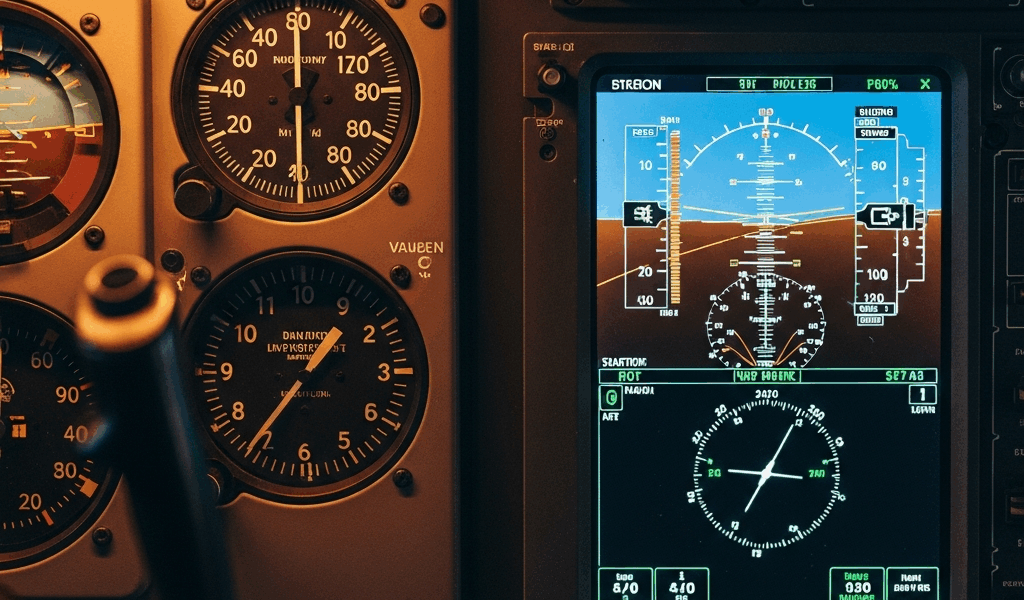
Glass Cockpit vs Steam Gauges for Student Pilots
Why This Decision Actually Matters for Your Training
The glass cockpit vs steam gauges debate has gotten complicated with all the conflicting advice flying around — Reddit threads, YouTube comments, that one guy at the FBO who learned in 1987 and has opinions. But here’s what most of that noise misses: this isn’t really a gear argument. It’s about what you’re hardwiring into your brain during those first 60 to 70 hours, and whether those habits hold up six months later when you climb into something completely different.
I started my private pilot training in a Cessna 172S with a Garmin G1000. Looked incredible. Felt overwhelming in a way I genuinely wasn’t prepared for. My CFI had to remind me — more than once — to stop staring at the moving map and actually look outside the airplane. That’s partly a student pilot problem, sure. But the panel made it worse before it made anything better. Don’t make my mistake of assuming a prettier display means easier flying.
Here’s what most articles skip entirely: the majority of student pilots don’t actually choose their panel. You fly what the school has. The local Part 61 school might have a 1979 Piper Cherokee with six analog gauges and a VOR head that drifts left. The Part 141 academy down the road might put you in a brand-new Cessna 172 Skyhawk SP with a G1000 NXi from day one. Neither automatically produces a better pilot. But understanding what each panel is teaching you — or hiding from you — changes everything about how you train.
This matters more if you have long-term goals. Going from steam gauges to glass is a manageable transition. Going the other direction, especially under the hood during an instrument rating, is a genuine shock for pilots who never built the underlying scan. I’ve watched it happen.
What Steam Gauges Teach You That Glass Can Hide
The classic six-pack — airspeed indicator, attitude indicator, altimeter, turn coordinator, heading indicator, and vertical speed indicator — forces you to build something called an instrument cross-check. You can’t just glance at one screen. Your eyes move deliberately between six individual instruments, each with its own needle, its own lag, its own failure mode. That discipline, built early, tends to stick around for your entire flying career.
Seasoned CFIs who insist on steam gauge primary training aren’t being nostalgic. They’ve watched glass-trained students struggle during partial panel maneuvers on instrument checkrides. When the attitude indicator fails on a G1000, the screen tells you clearly — big red X, hard to miss. When a vacuum-driven attitude indicator fails in a steam gauge airplane, it might just slowly lie to you. Learning to catch that difference, to cross-check instead of trust, is a real and transferable skill. That’s what makes steam gauges endearing to pilots who came up through traditional training.
That said, be honest about the limitations. Vacuum system failures are a legitimate safety concern in older aircraft. The engine-driven vacuum pump powering those gyroscopic instruments has a mean time between failures that’s uncomfortable to think about on an actual IFR flight. Older steam gauge trainers also typically lack traffic awareness systems and weather integration unless someone has paid to retrofit them. Plenty of 1970s Cessnas still in training fleets are running nothing but a nav/comm radio and a Mode C transponder.
- Six-pack scan builds transferable instrument cross-check habits
- Analog gauges teach you to recognize subtle failures, not just red X alerts
- Steam gauge training often produces more confident partial-panel performance
- Vacuum system reliability is a real limitation on older airframes
The scan you develop on steam gauges translates to every cockpit you’ll ever sit in. That’s the honest argument for it — not tradition, not nostalgia. Just transferability.
Where Glass Cockpits Give Student Pilots a Real Edge
I’m apparently someone who processes spatial information better on a moving map, and the Garmin G1000 works for me in ways that folded sectionals never quite did. After transitioning from steam gauge primary training into a G1000-equipped 172 for cross-country work, the mental bandwidth difference was immediate and obvious. The MFD — that 10.4-inch right-side display — shows terrain, ADS-B In traffic, TFRs, and nearest airports in a format that would have taken multiple radio calls and serious chart-folding gymnastics to replicate in an older airplane.
For cross-countries, that’s not a small thing. Students flying XC legs for the first time are already saturated — talking to approach, managing fuel, trying to find an airport they’ve never landed at. A moving map showing exactly where you are relative to controlled airspace isn’t a crutch. It’s a genuine workload reduction tool. One that lets you focus on actually flying the airplane instead of fumbling with a paper chart at 4,500 feet.
The G3X Touch in experimental aircraft and the G1000 NXi in certified trainers both integrate engine monitoring, flight planning, and comm management into one unified interface. The NXi upgrade — which many flight schools have been retrofitting into existing 172 fleets at roughly $30,000 to $40,000 per aircraft — adds split-screen capability and noticeably improved processing speed over the original G1000. Real differences, not just marketing.
The career argument holds up too. Regional airline cockpits are glass. Corporate aviation is glass. Nearly every turbine aircraft a career-track pilot will eventually fly uses some form of integrated flight deck. Training on glass early isn’t just preference. It’s familiarity with where professional aviation actually lives right now.
Checkride and FAA Practical Test Considerations
Probably should have opened with this section, honestly, because it’s what most students actually lose sleep over.
The FAA Airman Certification Standards for the private pilot practical test require demonstrated competency in certain tasks regardless of what panel you’re flying — unusual attitude recovery, partial panel flight, instrument cross-check. The DPE will cover these whether you’ve trained on a G1000 or a six-pack 172. No exceptions.
What changes is how those tasks feel. Partial panel on a steam gauge airplane means covering the attitude indicator and heading indicator with suction cup covers — physical, tactile, and honestly a little jarring. Partial panel on a G1000 means pulling up reversionary mode, which gives you a degraded PFD display. Both are valid. Both will be tested. But the muscle memory you’ve built in training determines how comfortable you are when the examiner springs it on you at 3,000 feet in actual IMC conditions.
FAA rules don’t restrict which panel type you train on or test in, as long as the aircraft is airworthy and meets certification requirements. You won’t be penalized for testing in a glass cockpit airplane. You will be expected to demonstrate that you understand the underlying concepts regardless of how they’re displayed on whatever screen is in front of you.
Which Panel Should You Train On First
So, without further ado, let’s dive into an actual answer — because vague hedging helps nobody.
If your goal is recreational flying and you’ll likely stay in the same aircraft type for years, this debate matters less than the internet argues. Fly what the school has. Learn it deeply. Move on.
If you’re career-track — aiming for an instrument rating, commercial certificate, CFI, and eventually airline or corporate work — there’s a real argument for at least some steam gauge exposure early. Specifically to build that cross-check discipline before glass makes it too easy to fixate on a single screen. A hybrid approach works well here. Primary training in a steam gauge airplane, advanced cross-country work in a G1000-equipped trainer. Best of both. Some schools in larger markets already structure training exactly that way.
Frustrated by unexpected delays and waitlists, many students sign up at the first school that has availability without asking the right questions first. Ask what aircraft the primary trainers are. Ask what avionics they’re running. Ask whether the school has both panel types and how they handle the transition between them.
That one conversation before you write the first check — and training is running $150 to $200 per hour in most U.S. markets right now — is worth considerably more than any gear debate you’ll find online at 11pm.


Stay in the loop
Get the latest aviation news updates delivered to your inbox.