Complex vs Simple Airports — What Pilots Need to Know
The whole controlled-vs-uncontrolled conversation has gotten complicated with all the half-explanations and vague textbook language flying around. I flew my first 60 hours out of a sleepy uncontrolled field in central Virginia — Shenandoah Valley Regional area, grass strip, maybe eight aircraft based there — then needed a checkout at a Class D before a cross-country. I was not prepared. Today, I will share it all with you, including the stuff nobody bothered to explain to me before I keyed up the wrong frequency in front of a busy tower controller.
What Makes an Airport Controlled or Uncontrolled
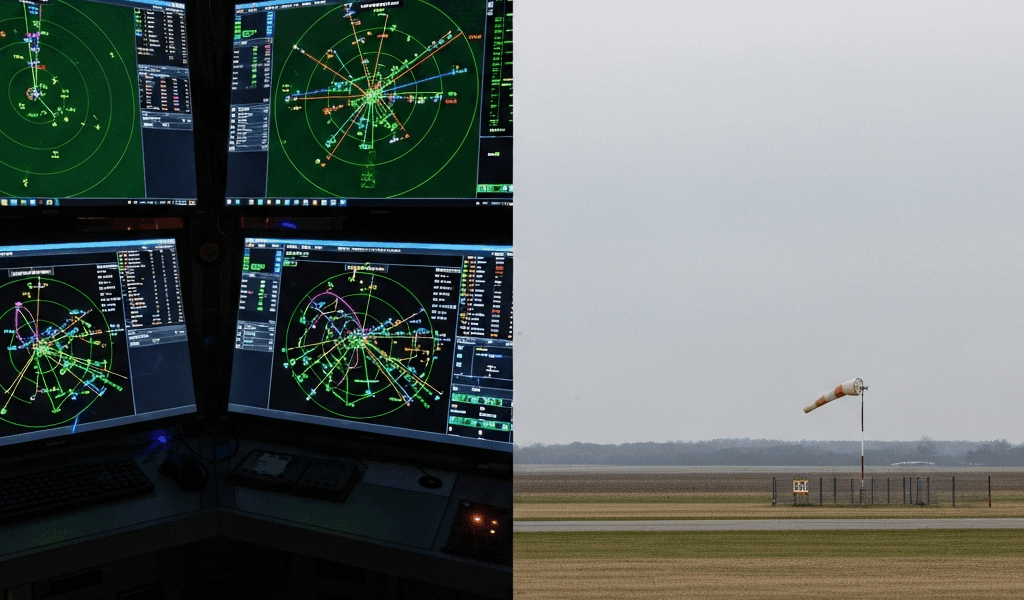
But what is a controlled airport, really? In essence, it’s any field with an operating control tower. But it’s much more than that. Class B, C, and D airports all fall under that umbrella — they differ in airspace size and traffic volume, not in the core rule about mandatory ATC communication. When the tower is open, you need a clearance. Full stop.
Uncontrolled airports sit in Class G airspace, or Class E that extends to the surface. No tower means no mandatory clearance. Pilots coordinate among themselves on a common frequency — CTAF, usually 122.8 or something field-specific. Some of these airports have paved runways, published instrument approaches, full-service FBOs charging $6.50 a gallon for 100LL. “Uncontrolled” doesn’t mean primitive. It means self-governed.
How Radio Communication Actually Differs
This is the one that trips people up. At a towered airport, you’re talking to someone with actual authority over your movement. Every clearance needs a readback. ATC tells you when to turn base, when to extend your downwind, when you’re cleared to land. You do not land without that clearance — at least if you want to keep your certificate.
A typical Class D inbound call from the south sounds something like: “Roanoke Tower, Cessna 172 November 4523 Uniform, ten miles south, two thousand five hundred, inbound full stop with information Bravo.” Tower assigns a squawk code, tells you to report a three-mile final, slots you into the sequence. Clean. Structured.
At an uncontrolled field, you’re making self-announce calls. Nobody responds with a clearance. Nobody sequences you. Entering left base for runway 27, you say: “Staunton traffic, Cessna 172 November 4523 Uniform, entering left base runway two-seven, Staunton.” That’s a position announcement. Not a request. You’re painting a picture for other pilots — not asking permission.
Don’t make my mistake. I treated those CTAF calls like ATC calls my first dozen times. Waited for a response. Half-expected someone to clear me. CTAF is advisory only. Silence on frequency doesn’t mean you’re cleared — it means nobody answered. Eyes outside matter more than ears on the radio at uncontrolled fields. Probably should have opened with that warning, honestly.
Traffic Flow and Situational Awareness at Each
Towered airports hand the sequencing job to ATC. They issue pattern instructions, call out conflicting traffic, and keep airplanes from converging on the same patch of sky. You still scan — ATC separation is not a substitute for looking out the window — but the organized layer of oversight is real and it matters.
At uncontrolled airports, pilots self-sequence. You listen, build a mental picture of who’s in the pattern, and adjust. Two pilots entering a 45-degree downwind entry simultaneously from opposite directions? Nobody catches that automatically. You are the conflict-detection system. The whole system.
Mid-air collisions happen disproportionately near uncontrolled airports. FAA accident data has supported this for decades — that’s not speculation. That doesn’t make small fields inherently dangerous. Most pattern work at a quiet Class G strip is completely routine. But the pilot workload for situational awareness is genuinely higher without a tower. Your position calls matter more, not less. Your eyes-outside habits become load-bearing in a way they simply aren’t when ATC is managing the flow.
Which Airport Type Is Better for Training and Currency
Both. And a smart training program uses both on purpose.
Uncontrolled airports are better for raw stick-and-rudder development. No tower sequencing between touch-and-goes. No extended downwinds for a Southwest 737 on a four-mile final. At a quiet grass strip with a single runway, you can run ten consecutive patterns in the time it takes to complete four at a busy Class D. For a student grinding repetitions in the flare, that volume of practice makes a measurable difference.
Frustrated by my own radio confusion after that first towered-airport solo checkout, I spent two full evenings listening to LiveATC.net recordings from Charlotte Douglas — a busy Class C — before I flew into one myself. I’d scribble down call-and-response patterns on a legal pad, $1.29 at the gas station, nothing fancy. That helped somewhat. But nothing replaced actually doing it with a CFI in the right seat.
Towered airports build a completely different skill set. ATC readbacks, holding short clearances, progressive taxi instructions, the handoff from ground control to tower — these are non-negotiable skills for IFR flying, Class B or C transitions, or any real cross-country operation. I’m apparently someone who needs to hear a thing fifty times before it sticks, and flying into Charlottesville-Albemarle a half-dozen times with an instructor finally made tower communication feel automatic. Many CFIs deliberately start students at uncontrolled fields to reduce cognitive load early, then introduce tower operations once basic airmanship is established. That sequencing makes sense.
For currency — staying sharp between flights — both types count. But if you haven’t flown into a towered airport in six months and you’re planning an IFR approach into a Class C, a quick VFR visit to a Class D first isn’t a bad idea. Ease back in rather than throwing yourself at the deep end.
When You Should Choose One Over the Other
Here’s a practical decision guide — at least if you want something more useful than “it depends”:
- Student pilot, solo endorsement, first solo flights — Uncontrolled field. Lower cognitive load, no ATC pressure, room to actually focus on flying the airplane instead of copying a frequency change.
- Student building radio skills before a first dual cross-country — Schedule at least one dual lesson at a Class D before going solo cross-country. Tower communication needs deliberate practice, not surprise exposure at a busy field.
- Private pilot doing pattern work for currency — Uncontrolled airport. Faster cycles, less waiting, more landings per hour of Hobbs time.
- Pilot building instrument currency and wanting radar services — Towered airport with approach control. Request flight following or file an IFR flight plan — you’ll get vectors and a real-world IFR environment without leaving the practice area.
- Cross-country pilot needing fuel at an unfamiliar towered field — Pull up the Chart Supplement entry before you’re within 30 miles. Know the ATIS frequency, ground control frequency, and any published hotspot notes. Arriving unprepared at an unfamiliar Class D just wastes everyone’s time — including yours.
- Night flight, building night currency — Either works, but uncontrolled airports after dark demand sharper situational awareness. Traffic that’s obvious in daylight can disappear completely at night if pilots start skipping position calls. Make every call, every time. No exceptions.
That’s what makes developing versatility across both environments so valuable to us pilots who actually want to go places. The ones who get genuinely comfortable in the system aren’t the ones who mastered one type of airport — they’re the ones who deliberately sought out both, paid attention to what each one demanded, and flew each on its own terms. Know where you’re going. Know what it requires. Show up ready.



Stay in the loop
Get the latest aviation news updates delivered to your inbox.