
X-59 QueSST: NASA’s Supersonic Quiet Aircraft
Supersonic aviation discussions have gotten complicated with all the “why did commercial supersonic travel disappear after Concorde and what would it take to bring it back” debates, the sonic boom noise regulations versus supersonic speed capability comparisons, and “what exactly is NASA doing with the X-59 and why does it matter for commercial aviation’s future” conversations flying around. Today, I will share it all with you.
But what is the X-59, really? In essence, it’s NASA’s experimental aircraft specifically designed to prove that supersonic flight over land is possible without the disruptive sonic boom that made Concorde impractical for overland routes — a quiet supersonic technology demonstrator whose test data is intended to inform new FAA and ICAO regulations that could eventually allow commercial supersonic service over populated areas. But it’s much more than a fast airplane. For the future of commercial aviation and the several companies currently developing supersonic transports, the X-59’s success or failure at generating acceptable noise levels will determine whether the regulatory door opens for routes that Concorde could never fly.
The Problem the X-59 Solves
Concorde was capable of Mach 2 cruise but was banned from supersonic flight over the continental United States and most land masses because its sonic boom — a continuous double crack generated by shock waves from the aircraft’s nose and tail — was deemed unacceptable for communities below the flight path. This restriction confined Concorde to trans-Atlantic and other over-water routes, fundamentally limiting its commercial network and economic viability. Don’t make my mistake of assuming the sonic boom problem is inherent to all supersonic aircraft — at least if you’re following new supersonic transport development, because modern aerodynamic design tools and computational fluid dynamics have revealed specific aircraft configurations that reshape the shock wave signature into something dramatically quieter, and the X-59 is the physical proof-of-concept for those computational findings.
X-59 Design Features
The X-59 QueSST (Quiet SuperSonic Technology) is a single-engine experimental aircraft developed by Lockheed Martin Skunk Works for NASA’s Low-Boom Flight Demonstrator program. Key design elements include:
- Elongated nose: The X-59’s 94-foot length with a dramatically elongated nose redistributes the shock wave energy across the aircraft’s length, preventing the shock waves from coalescing into the sharp double-boom that characterizes conventional supersonic aircraft
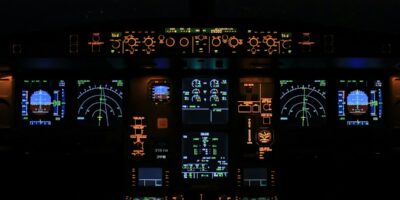
- No forward-facing cockpit window: The nose is so long that a traditional forward window is impossible — the pilot uses an eXternal Vision System (XVS) combining cameras and a 4K monitor to provide the forward view that a cockpit window would normally provide
- GE F414 engine: A single engine rated at 22,000 pounds of thrust with the exhaust positioned above the fuselage to shield its noise signature from the ground
- Cruise design point: Mach 1.4 at 55,000 feet, designed to produce a ground-level noise signature of approximately 75 PLdB — roughly equivalent to a car door closing rather than a sonic boom
The Quiet Supersonic Boom Goal
NASA’s target for the X-59 is a perceived loudness of 75 PLdB (perceived level in decibels) at the ground during supersonic cruise — compared to Concorde’s approximately 105 PLdB. That 30 PLdB difference corresponds to a dramatic reduction in perceived loudness; each 10 PLdB reduction represents roughly a halving of perceived sound intensity.
Community Overflight Testing Plan
Once NASA completes X-59 flight testing to verify its acoustic performance, the plan is to fly the aircraft over selected U.S. communities and survey residents about their experience of the sound. This community response data is the specific product that regulatory agencies need. First, you should understand that the X-59 program’s most important output is not the aircraft itself but the noise survey data collected during community overflights — at least if you’re evaluating what this program means for commercial supersonic aviation’s future, because the regulatory change that would allow supersonic flight over land requires demonstrated evidence of community acceptability, and NASA is the organization positioned to generate that evidence through systematic testing that a private company could not conduct with the same credibility.
Implications for Commercial Supersonic Aviation
Several companies are developing supersonic transport concepts — including Boom Supersonic’s Overture and Aerion’s AS2 (now suspended) — that would benefit directly from regulatory changes enabled by X-59 test data. The difference between an overland-capable supersonic transport and one restricted to over-water routes is the difference between a commercially viable network and a niche product for trans-oceanic routes only. New York to Los Angeles in under three hours rather than over five represents a genuine travel time transformation for business aviation customers willing to pay premium fares. The X-59 program is the technical and regulatory foundation that makes that network possible — or confirms it remains impractical for another generation.
Recommended Aviation Gear
This section includes affiliate links. We may earn a commission at no extra cost to you.
David Clark H10-13.4 Aviation Headset
The industry standard for aviation headsets.
$376.95
Check Price on AmazonPilots Handbook of Aeronautical Knowledge
Essential FAA handbook for every pilot.
$25.42
Check Price on Amazon

Stay in the loop
Get the latest aviation news updates delivered to your inbox.