
Today, I will share it all with you.
But what does IFR stand for in aviation, really? In essence, IFR stands for Instrument Flight Rules — the regulatory framework that governs flight when pilots cannot maintain safe separation from terrain, traffic, and obstructions by looking outside. But it’s much more than an acronym. For pilots operating in clouds, reduced visibility, or at night in IMC, IFR is the complete system of procedures, equipment requirements, training standards, and ATC coordination that makes flight safe when visual references aren’t available.

The Basics of IFR
IFR involves a regulatory framework that specifies how flights must operate when visibility is below the Visual Flight Rules minimums — generally when visibility is less than 3 miles or the cloud ceiling is below 1,000 feet AGL in controlled airspace. Under IFR, the pilot relies on cockpit instruments for attitude, altitude, heading, and navigation. ATC provides separation services. The combination of pilot instrument skills, aircraft equipment, and ATC oversight is what makes IFR viable in conditions where a pilot looking out the window sees nothing useful.
Key Instruments in IFR
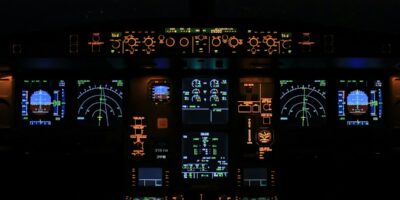
- Altimeter: Measures the aircraft’s altitude — set to the local altimeter setting for accurate MSL readout
- Airspeed Indicator: Shows the aircraft’s speed through the surrounding air mass
- Attitude Indicator: Depicts the aircraft’s pitch and bank relative to the horizon — the primary scan instrument in IMC
- Heading Indicator: Shows the aircraft’s magnetic heading, gyroscopically stabilized against compass lag
- Vertical Speed Indicator: Shows rate of climb or descent in feet per minute
Don’t make my mistake of treating these instruments as independent readings — at least if you’re learning IFR, because the instrument scan involves integrating all of them simultaneously, not reading each one in sequence. The attitude indicator drives everything else.
IFR vs. VFR
Visual Flight Rules require pilots to maintain specific minimum visibility and cloud clearance distances. VFR pilots navigate by ground reference, see and avoid other traffic visually, and are responsible for their own separation from terrain. IFR removes the visibility dependency — an IFR-rated pilot in an IFR-equipped aircraft can legally operate in zero visibility in controlled airspace, with ATC providing traffic separation and the instruments providing flight path control.
Flight Planning Under IFR
IFR flight plans filed with ATC include the departure airport, route, altitude, destination, alternate airport, estimated time en route, and fuel endurance. ATC uses filed flight plans to pre-plan the traffic flow, assign routes, and coordinate between control facilities. Unlike VFR flight plans (which are purely advisory), IFR clearances carry legal authority — pilots are required to fly the cleared route, altitude, and restrictions, deviating only for safety of flight emergencies.
Instrument Approaches
Landing under IFR requires executing an instrument approach procedure — a published sequence of headings, altitudes, and timing that brings the aircraft from en-route altitude to the runway environment. Approach categories differ by guidance quality:
- Precision Approaches (PA): Provide lateral and vertical guidance — ILS approaches can take minimums down to 200 feet ceiling and 1/2 mile visibility, or lower for CAT II/III
- Non-Precision Approaches (NPA): Provide lateral guidance only — VOR and NDB approaches typically have higher minimums
- APV Approaches: Approaches with vertical guidance using RNAV/GPS, providing precision-like guidance without meeting full precision approach criteria
Training and Certification
The instrument rating in the US requires a minimum of 50 hours of cross-country flight time as pilot in command, 40 hours of actual or simulated instrument time, and a knowledge test and checkride administered by an FAA examiner. The instrument rating checkride tests approach procedures, holds, intercepting and tracking courses, partial-panel flying, and unusual attitude recovery.
ATC’s Role in IFR Operations
IFR flight depends on ATC in a way VFR flight does not. Controllers assign altitudes, headings, speeds, and routes. They provide traffic separation using radar returns and transponder data. In busy terminal airspace, IFR arrivals are sequenced, vectored, and handed off between controllers through the approach. First, you should understand that IFR clearances are not suggestions — at least if you’re new to IFR operations, because deviating from an ATC clearance without authorization (other than for safety of flight) is an FAA violation, not just a procedural inconvenience.
Autopilot and IFR
Modern autopilot systems are integral to IFR operations in equipped aircraft. They reduce workload by maintaining headings, altitudes, and tracks while the pilot manages navigation, communication, and systems. Advanced autopilots can fly complete instrument approaches to minimums. Even in aircraft with capable autopilots, instrument pilots must remain proficient at hand-flying in IMC — equipment failures happen, and the ability to hand-fly the aircraft to minimums is what the instrument rating training and checkride actually tests.
Future of IFR Technology
Satellite-based augmentation systems like WAAS provide GPS approach guidance with accuracy comparable to ILS, expanding instrument approach availability to airports that never had ground-based precision approach capability. Synthetic vision systems display a terrain and traffic picture on the primary flight display, giving pilots spatial awareness in IMC that older glass cockpits couldn’t provide. Autonomous systems are beginning to incorporate IFR-equivalent capability — but the regulatory and certification path for autonomous IFR operations in commercial airspace remains years away from routine deployment.
Recommended Aviation Gear
This section includes affiliate links. We may earn a commission at no extra cost to you.
David Clark H10-13.4 Aviation Headset
The industry standard for aviation headsets.
$376.95
Check Price on AmazonPilots Handbook of Aeronautical Knowledge
Essential FAA handbook for every pilot.
$25.42
Check Price on Amazon

Stay in the loop
Get the latest aviation news updates delivered to your inbox.