Military Helicopters: Names, Types, and Capabilities
Military rotorcraft have gotten complicated with all the attack versus utility versus transport categorization debates, the multi-role versus specialized platform discussions, and “what each helicopter is actually optimized for” questions flying around. Today, I will share it all with you.
But what makes military helicopters distinct, really? In essence, each type represents a design optimization tradeoff between speed, firepower, lift capacity, survivability, and range — and different missions require different points on that tradeoff curve. But it’s much more than a capability spec. For the crews and ground forces who depend on these aircraft, the operational differences between a dedicated attack helicopter and a utility helicopter determine what’s possible in a given situation.
AH-64 Apache
The AH-64 Apache is the US Army’s primary attack helicopter — a twin-turboshaft platform designed specifically to find and destroy armored vehicles, not transport troops. The nose-mounted sensor suite integrates target acquisition and night vision systems that allow the crew to detect, identify, and engage targets at standoff ranges in darkness. The weapons suite combines the 30mm M230 chain gun for close-range engagement with AGM-114 Hellfire missiles for standoff anti-armor strikes. Don’t make my mistake of treating Hellfire as just an anti-tank weapon — at least if you’re following current military operations, because the missile family has expanded to include variants optimized for soft targets, personnel, and urban engagement scenarios that the original design didn’t contemplate.
UH-60 Black Hawk
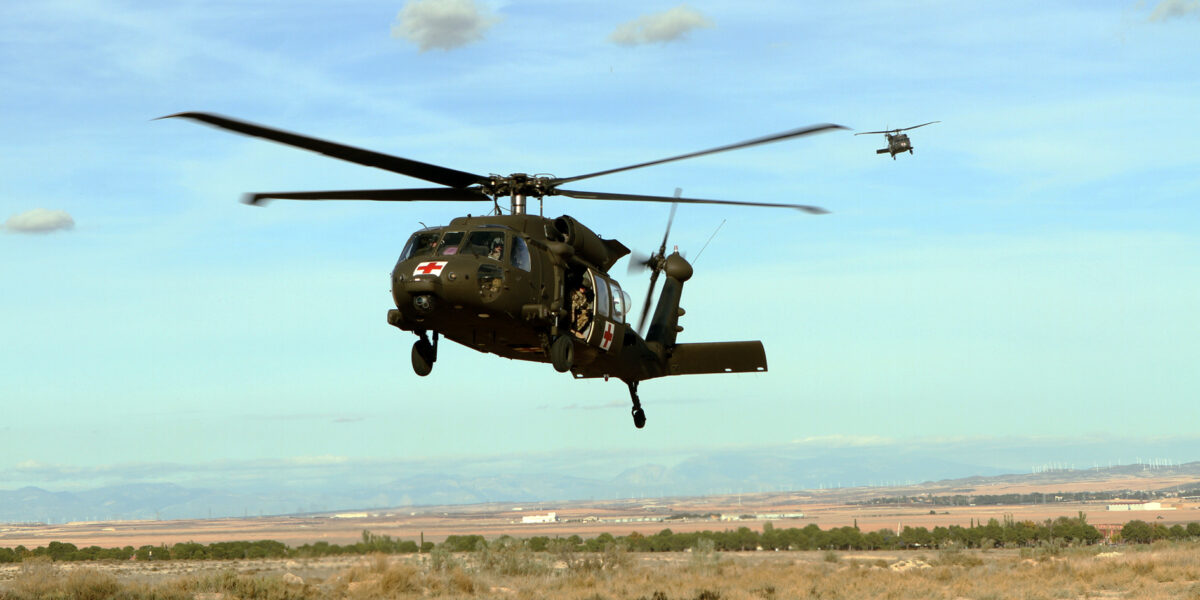
The UH-60 Black Hawk is the workhorse of US Army aviation — a utility helicopter used for air assault, air cavalry, medical evacuation, command and control, and special operations support. The design philosophy prioritized survivability and operational flexibility over specialization, producing an airframe that has proven adaptable to configurations the original designers didn’t anticipate. Advanced avionics and electronic systems add capabilities progressively through successive variants.
CH-47 Chinook
The CH-47 Chinook uses a tandem rotor configuration — two rotors on the same axis but on separate masts fore and aft — that eliminates the need for a tail rotor and puts all available power into lift. The result is a heavy-lift helicopter capable of carrying troops, artillery pieces, vehicles, and external sling loads that exceed what any single-rotor helicopter of comparable weight can manage. Battlefield resupply at high altitude — carrying loads to mountain positions where density altitude limits single-rotor performance — is one of the operational niches where the Chinook’s lift capacity is difficult to replace.
Mil Mi-24 Hind
The Mi-24 Hind is the Soviet and Russian design tradition’s answer to the attack helicopter question — but with a twist that Western attack helicopter design explicitly rejected: it carries troops. The Mi-24 combines a heavily armed attack platform with a troop transport cabin that can carry 8 personnel or a medical evacuation configuration. The concept of an assault helicopter that can suppress landing zone defenses and then deliver troops from the same airframe was operationally appealing but produced an aircraft larger and less agile than purpose-built attack helicopters. Combat experience in Afghanistan showed both the platform’s capabilities and its limitations.
Bell AH-1 Cobra
The AH-1 Cobra was the first purpose-built attack helicopter to enter combat — the aircraft that established the tandem-seating, streamlined-fuselage design philosophy that dedicated attack helicopters have followed since. The Marine Corps’ AH-1Z Viper is the current production variant, with a four-blade composite rotor and T700 engines that make it essentially a new aircraft on the conceptual foundation of the 1960s original. The 20mm M197 three-barrel cannon and the weapons pylons capable of carrying Hellfire missiles, rockets, and air-to-air missiles make the Viper a capable modern attack helicopter despite the design lineage going back six decades.
Eurocopter Tiger
The Tiger is Europe’s multi-role attack helicopter — developed jointly by France and Germany, with Australia as a third operator. The stealth characteristics are relative rather than absolute: reduced radar cross-section and infrared signature compared to conventional attack helicopters, not the signature reduction associated with fixed-wing stealth programs. Advanced avionics include integrated helmet-mounted targeting that allows the crew to cue weapons systems by looking at the target. The Tiger’s multi-role design serves both armed reconnaissance and ground attack missions, though the operational experience across different operators has revealed capability gaps addressed through successive software and systems upgrades.
NHIndustries NH90
The NH90 is a European medium utility helicopter developed for both tactical transport (TTH) and naval frigate-based maritime variants (NFH). First, you should understand that the NH90 program has been one of the most complex multinational military helicopter programs in history — at least if you’re evaluating why European defense procurement produces different outcomes than US programs, because the requirement to satisfy French, German, Italian, Dutch, and Norwegian specifications simultaneously produced a development and qualification process that extended far beyond original timelines. The production variants differ between nations to the degree that interoperability between national NH90 fleets is more complex than the original multinational program concept anticipated.
Kamov Ka-52 Alligator
The Ka-52 uses the coaxial rotor system that Kamov has employed across its helicopter line — two counter-rotating rotors on the same shaft, eliminating tail rotor torque compensation and producing a compact, powerful platform. The Ka-52 features side-by-side crew seating rather than tandem, which differs from Western attack helicopter design but simplifies crew coordination in some tactical scenarios. Designed primarily to destroy armored vehicles and helicopters, the Ka-52 has seen combat operations in Syria and Ukraine, where operational performance and survivability have been evaluated under actual combat conditions rather than just exercise data.


Stay in the loop
Get the latest aviation news updates delivered to your inbox.